![WISNU [W] WISDANTIO](https://wisnuwisdantio.com/wp-content/uploads/2017/11/cropped-header-20172.jpg)

(2021 – 2022)
The “New Taipei City Art Museum’s Annual Art STEAM Teaching Plan Development 2021” is a framework of educational promotion and course plans as an annual program of the New Taipei City Museum of Art organized by Hide & Seek Audiovisual Art. Under the framework, artists and teachers were invited and matched to develop art STEAM (Science, Technology, Engineering, Art, Math) teaching course plans with art as the core that is suitable for students at different education stages, combining multiple cross-domain, design thinking, hands-on operation and improve the problem-solving skills.
In the 2021 Art Steam annual program, “Wawies” Wisnu Wisdantio works as a co-artist for Yang Ching-wen (Club Bing Beng) who work together with Wang Lu-Yu and Fang Ya-Ling as teachers to develop the art STEAM course “Illusionary Art Land (幻遊藝境)” for students at Tur Ya Kar Elementary & Junior High School (桃子腳國中小) from October 2021 to February 2022. The course focuses on the importance of technology as a crucial part of children’s education and emphasises the idea of making the students more familiar with technology, learning how it works, and eventually working with it rather than simply engaging it as a user.

Within The Illusionary Art Land (幻遊藝境) course, Yang Ching-wen has an opportunity to work with art class students at Tur Ya Kar Elementary & Junior High School (桃子腳國中小) and represents how an illusion technique can be utilised to create a “holographic ghostly image projection”. It’s an ancient mechanism based on natural physics that was revived by British scientist Henry Dircks and popularized by John Henry Pepper who implemented it into a theatre performance of Charles Dickens’s “The Haunted Man” in 1862. Until recently, the technique called Pepper’s Ghost Illusion has been adopted and developed into various forms of sophisticated technology as part of modern performing arts. At the first step of the course, students had an opportunity to learn the basic principles of projection works and explore how to re-engineer a simple pyramid plexiglass to transform an image or animation from their smartphone into an optical illusion technique called “Pepper’s Ghost illusion” or even play with light to enact their own ghostly characters.


Documentation by Wang Lu-Yu and Fang Ya-Ling
Meanwhile, teacher Lu-yu and teacher Ya-ling work together in the course to guide the students to create their own ghostly characters through their toys or various objects. When most of the time those things are only alive within the student’s imagination, with the help of affordable devices such as smartphones or tablet computers that are easily accessible to students in their daily lives, the students have an opportunity to explore and bring their imagination into reality as if those characters can really move or alive. Where they learn how to make a simple animation from their toys with the Stop Motion technique, it is a technique in which objects are physically manipulated in small increments between individually photographed frames so that they will appear to exhibit independent motion or change when the series of frames is played back. In the end, through this process, the students can create their own character animation based on their own stories or imagination to be displayed virtually with Pepper’s ghost installation and presented within a small exhibition at their school.


Documentation by Wang Lu-Yu and Fang Ya-Ling
In order to support the art STEAM course “Illusionary Art Land,” which focuses on teaching students how technology works and how to work with it, “Wawies” Wisnu participates in developing a customized design for Pepper’s Ghost installation. Instead of presenting it as a fixed or ready-to-use installation, he designed the V.01.4 model in a knock-down kit, a simplified version of the Do-It-Yourself installation that can be assembled by the student during the course and dismantled back after use. As a science kit, this model is expected to be suitable to be built by students at different education stages whether individually or in-group and enrich their exploration process with experiences in design thinking, hands-on operation, and improving their problem-solving skills.
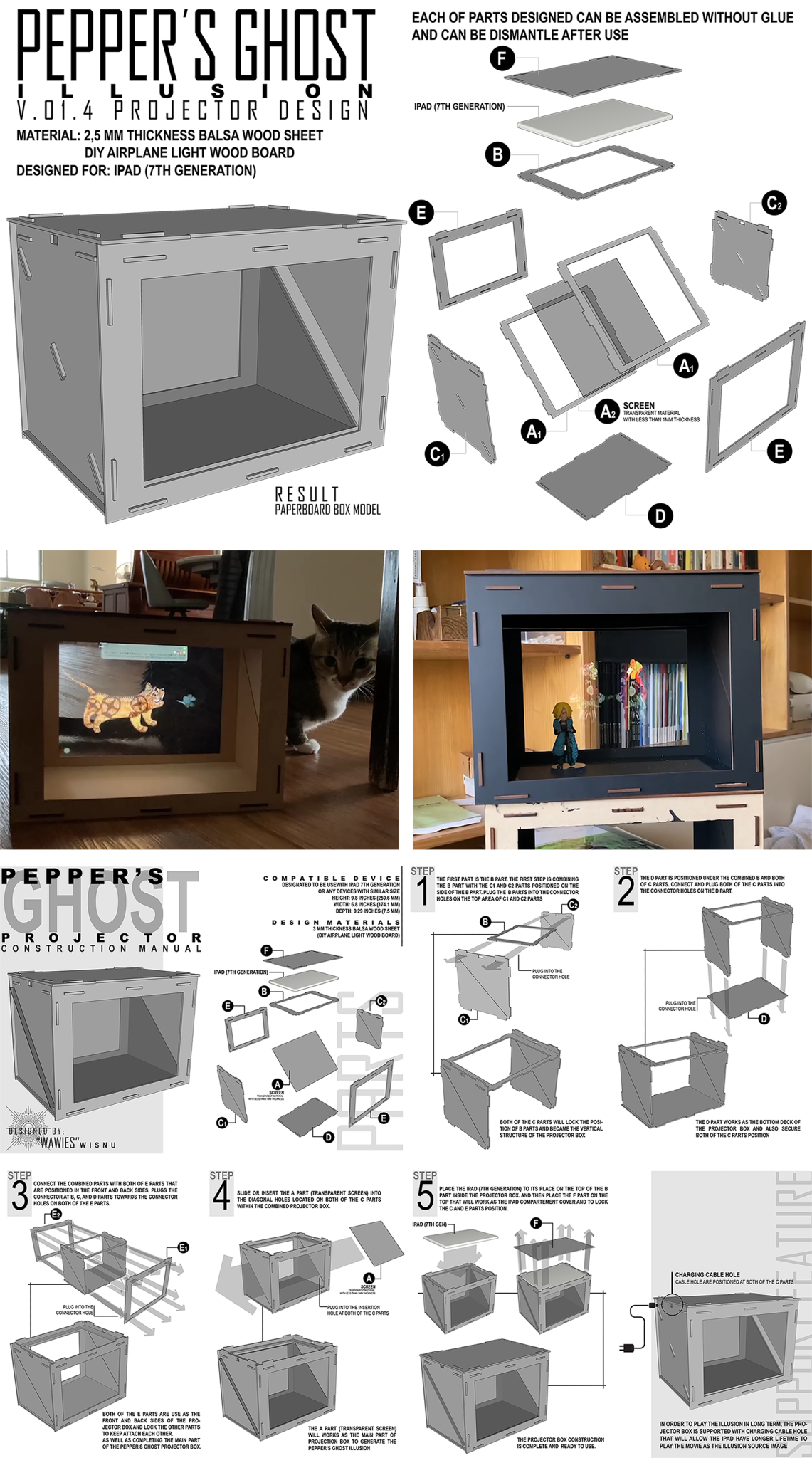


Documentation by Wang Lu-Yu and Fang Ya-Ling
Eventually, the students were divided into several working groups and finished building their own V.01.4 projector guided by the step-by-step assembly instructions, they stepped into the final part of The Illusionary Art Land (幻遊藝境) course. Each student group used the projector to convert their “Stop-Motion” artwork video into a holographic character and present it to their friends in a small exhibition within the Tur Ya Kar Elementary & Junior High School (桃子腳國中小).
“Illusionary Art Land” (幻遊藝境) Exhibition Documentation
courtesy of Tur Ya Kar Elementary & Junior High School (桃子腳國中小) teachers Documentation
Research And Development Documentation:
* The Pepper’s Ghost V.01.4 Science Kit Projector Development Documentation
Reference Site:
* Details of “New Taipei City Art Museum’s Annual Art STEAM Teaching Plan Development 2021” On New Taipei City Art Museum’s official website.
* Details of Hide & Seek Audiovisual Art official website.
* Details of Club Bing Beng on the Facebook page.
* Details of Tur Ya Kar Elementary & Junior High School (桃子腳國中小) official website.





 WISNU [W] WISDANTIO
You must be logged in to post a comment.