Community Learning Workshop about Basic Photography, Photo Composition, and Basic Travel Writing. (2023)
___________________________________________
This is a series of presentations as part of a comprehensive year-long extracurricular activities program for students of SMA Pangudi Luhur Sedayu who join the “Calvari” – Pecinta alam community. The “Pecinta Alam” community refers to a group of students who share a common interest in nature, outdoor activities, and environmental conservation. These communities are often involved in various outdoor pursuits, such as hiking, camping, mountaineering, bird watching, and other activities that allow members to connect with and appreciate the natural environment.
The first part of the knowledge introduction and discussion was held on Nov 7th, 2013, where we talked and learned about basic photography knowledge. Begin with the basic knowledge about the works of a camera to produce a photograph, as well as introduce the difference between various types of cameras, such as analogue cameras, digital cameras, mirrorless cameras, and the camera that builds as part of the handphone – a handy device that is mostly used recently to take photos nowadays driven by its mobility and ease of use. The discussion also talked about the basic photo composition as a bridge to talk about the work of a photograph as a tool to freeze or capture a moment as well as a tool to represent or retell the photographer’s memorable moment or particular story. Eventually, the gathering ended with a free-flow discussion about various topics, such as the photography simple technique, photo result discussion, angle, timing, macro photo, and so on.
The second part of the discussion was held on Nov 14, 2013, where we talked and learned about basic Travel Writing. During the discussion, we talked about the practice of travel writing and its benefit to documenting a travel journey in an interactive model without leaving its important role as a scientific journal. The discussion is focused on learning the basic definition of a travel journal, the research process during the trip, and learning to wrap all the experiences through a travel journal. We also discussed and learned to share it all in the form of an interactive article through specific travel writing methods that can be combined with the help of photo documentation that we learned from the previous workshop. In the end, the sharing is reaching the discussion about the probability and opportunity of travel writing and photo travel to produce a travel journal in various forms and methods such as making it as a travel journal e-book, printing it as a collection book, or even publishing it as an article on a personal or organization website.
The Magic Lantern How To Buy And How To Use It and How To Raise A Ghost by “A Mere Phantom” (1876)
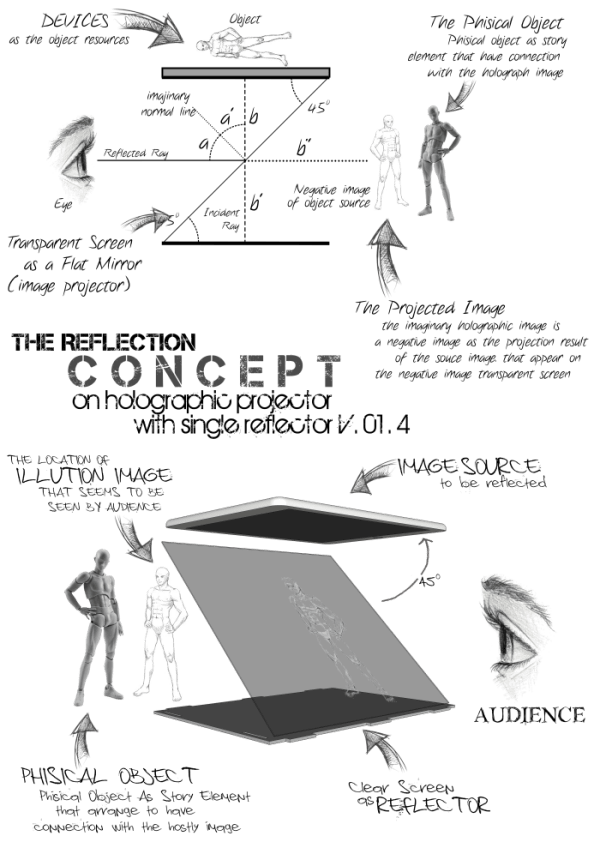
The V.01.4 prototype is developed under several contexts to support a STEAM education course that focuses on the importance of technology as a crucial part of children’s education. The course emphasises making the students more familiar with technology, learning how it works, and eventually working with it rather than simply engaging it as a user. The first determining factor is developing the V.01.4 prototype as a science learning kit, where the students learn how the “Pepper’s Ghost illusion” technique actually works and eventually build a tool to re-enacting it that utilises the law of reflection to create a ghostly image as a reflection of an actual object through a transparent mirror. The second factor is the need to design to be integrated with digital technology-based devices that are affordable and accessible easily to students in their daily lives, such as the Internet, smartphones, tablets, and other forms of digital devices. Where in this case, those devices are provided by their school as tools for students to learn how to design their own artwork or even make a simple animation as the source image to be projected by Pepper’s Ghost Holographic Projector V.01.4 in the form of a virtual ghostly character.
Driven by the first contexts, The V.01.4 prototype design is developed by re-examining the previous versions of Pepper’s Ghost Projector, especially the mini version of the V.01.3 projector prototype that was designated as an exhibition installation to present certain content. Thus, there was a need to customize the V.01.3 design to meet its development purposes as part of an educational course. The first idea is to bring the V.01.4 mechanism developed based on the V.01.3 design and reduce its mechanism to adopt John Pepper’s installation simplicity that was utilized within “The Haunted Man” performance production in 1862, which only implements a simple transparent screen to enact the ghostly figure illusion. The other thing is the connectivity or interaction between the illusion and the other actors or even the physical environment during the performance that emphasises the illusion’s ghostly appearance. So, besides implementing the transparent screen with a simple mechanism to enact the illusion, the V.01.4 prototype can also be used to present a physical object and the real environment behind the transparent screen.
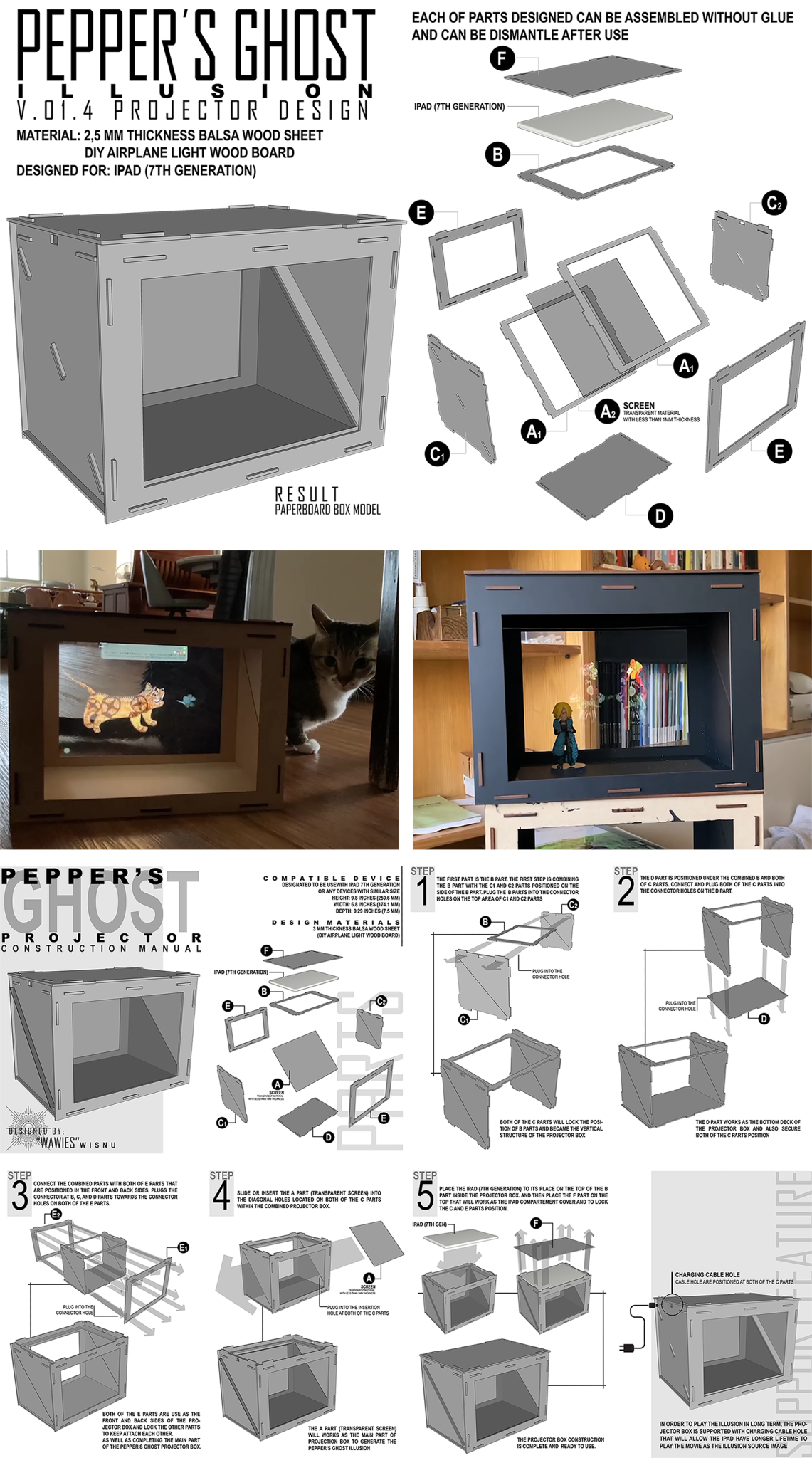
Meanwhile, following the first context that focused on learning how the Pepper Ghost illusion mechanism works, the second context drives the development of V.01.4 prototype design as an interactive learning kit in the form of a simple knock-down kit that is easy to build, a simplified version of the Do-It-Yourself installation, which is suitable to be built by students at different education stages whether individually or in-group and enriches them with experiences in design thinking, hands-on operation, as well as improves their problem-solving skills.
Those design contexts drive the V.01.4 development by enhancing and customizing the former V.01.3 prototype design, which is designed to be integrated with an iPad as a digital technology-based device that is affordable and accessible easily nowadays. Within the exploration process from August until November of 2021, the development of the Pepper’s Ghost Holographic Projector With Single Reflector V.01.4 model spread into several developments, such as:
Following the idea of the Mini V.01.3 design, the V.01.4 is designed for a tablet computer with a 10″ display size as the source image or object. As well as keep using the 3/4 mm plexiglass as the transparent sheet reflector.
The V.01.4 model is also designed with 2 compartments, which are the illusion mechanism compartment and the holographic projection with the physical object compartment. However, instead of using a flat mirror as the image converter, the V.01.4 model is designed without a mirror element in order to make the mechanism as simple as possible and keep the source image still hidden in the illusion mechanism compartment.
The other customisation is replacing the stage for the physical object compartment. instead of using a stage to place a physical object, the wall on the projection compartment is being cut and the image will be projected in a hollow place where the audience can see the environment behind the V.01.4 projector box.
The last customisation of Pepper’s Ghost Holographic Projector With Single Reflector V.01.4 model was designed in the form of a simple knock-down kit that is easy to build.
Those developments brought the first sketch idea of the V.01.4 projector design concept, which is influenced by a shoe box design where easy to find as a common thing in almost every household.
However, after reviewing and building the first prototype, several flawless were found in the construction process. The building process is considered too complicated and takes a lot of time. In other circumstances, since the parts are connected to each other with glue, it appears that the connections tend to be weak and easy to fall apart. It brings a new idea to make the projector box in the form of a simple knock-down as if a puzzle, where each part is connected through a pin and hole system. A system where it can be built easily and can be dismantled after use.
The Science-Kit Design project as part of the art STEAM education courses for elementary school students under the framework of “New Taipei City Art Museum’s Annual Art STEAM teaching plan development 2021” (2021 – 2022)
___________________________________________
The “New Taipei City Art Museum’s Annual Art STEAM Teaching Plan Development 2021” is a framework of educational promotion and course plans as an annual program of the New Taipei City Museum of Art organized by Hide & Seek Audiovisual Art. Under the framework, artists and teachers were invited and matched to develop art STEAM (Science, Technology, Engineering, Art, Math) teaching course plans with art as the core that is suitable for students at different education stages, combining multiple cross-domain, design thinking, hands-on operation and improve the problem-solving skills.
In the 2021 Art Steam annual program, “Wawies” Wisnu Wisdantio works as a co-artist for Yang Ching-wen (Club Bing Beng) who work together with Wang Lu-Yu and Fang Ya-Ling as teachers to develop the art STEAM course “Illusionary Art Land (幻遊藝境)” for students at Tur Ya Kar Elementary & Junior High School (桃子腳國中小) from October 2021 to February 2022. The course focuses on the importance of technology as a crucial part of children’s education and emphasises the idea of making the students more familiar with technology, learning how it works, and eventually working with it rather than simply engaging it as a user.
Within The Illusionary Art Land (幻遊藝境) course, Yang Ching-wen has an opportunity to work with art class students at Tur Ya Kar Elementary & Junior High School (桃子腳國中小) and represents how an illusion technique can be utilised to create a “holographic ghostly image projection”. It’s an ancient mechanism based on natural physics that was revived by British scientist Henry Dircks and popularized by John Henry Pepper who implemented it into a theatre performance of Charles Dickens’s “The Haunted Man” in 1862. Until recently, the technique called Pepper’s Ghost Illusion has been adopted and developed into various forms of sophisticated technology as part of modern performing arts. At the first step of the course, students had an opportunity to learn the basic principles of projection works and explore how to re-engineer a simple pyramid plexiglass to transform an image or animation from their smartphone into an optical illusion technique called “Pepper’s Ghost illusion” or even play with light to enact their own ghostly characters.
Documentation by Wang Lu-Yu and Fang Ya-Ling
Meanwhile, teacher Lu-yu and teacher Ya-ling work together in the course to guide the students to create their own ghostly characters through their toys or various objects. When most of the time those things are only alive within the student’s imagination, with the help of affordable devices such as smartphones or tablet computers that are easily accessible to students in their daily lives, the students have an opportunity to explore and bring their imagination into reality as if those characters can really move or alive. Where they learn how to make a simple animation from their toys with the Stop Motion technique, it is a technique in which objects are physically manipulated in small increments between individually photographed frames so that they will appear to exhibit independent motion or change when the series of frames is played back. In the end, through this process, the students can create their own character animation based on their own stories or imagination to be displayed virtually with Pepper’s ghost installation and presented within a small exhibition at their school.
Documentation by Wang Lu-Yu and Fang Ya-Ling
In order to support the art STEAM course “Illusionary Art Land,” which focuses on teaching students how technology works and how to work with it, “Wawies” Wisnu participates in developing a customized design for Pepper’s Ghost installation. Instead of presenting it as a fixed or ready-to-use installation, he designed the V.01.4 model in a knock-down kit, a simplified version of the Do-It-Yourself installation that can be assembled by the student during the course and dismantled back after use. As a science kit, this model is expected to be suitable to be built by students at different education stages whether individually or in-group and enrich their exploration process with experiences in design thinking, hands-on operation, and improving their problem-solving skills.
Eventually, the students were divided into several working groups and finished building their own V.01.4 projector guided by the step-by-step assembly instructions, they stepped into the final part of The Illusionary Art Land (幻遊藝境) course. Each student group used the projector to convert their “Stop-Motion” artwork video into a holographic character and present it to their friends in a small exhibition within the Tur Ya Kar Elementary & Junior High School (桃子腳國中小).
A board game as an interactive installation made in the context of Jinguashi – Shuinandong – Jiufen and represents those areas’ identity changes throughout the time (2019)
The collaborative work, Deposits of the Island, aims to build a place of encounter and exchange. It invites audience to become the agents in this journey, using sound and playful games as a medium to evoke hidden stories and to “extract” the layers of historical, geographical, and memory in Jinguashi. It also dives into the body memories of migrant workers gathering around ASEAN Plaza and aims to initiate dialogues through the touch of massage. With this work, OCAC and Lifepatch aim to lead the audience through the “hand of the deities” — to learn the spices, herbs, and liquor from Taiwan and Indonesia, and further explore their customs, histories, cultures, and transformative impacts in the contemporary world.
– exhibition curatorial, 2019 –
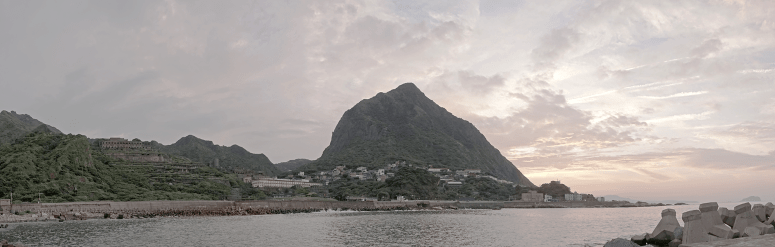
The Shuinandong Smelter on panorama view of Lianxin Village, Ruifang District
Large tiered construction with a fortress-like appearance known as “The Remains of the 13 Levels” stands firm following the hillside of Ruifang district. Although abandoned for decades and slowly engulfed by nature, those Shuinandong smelter remnants’ iconic size and spectacular setting never failed to show the gold rush glorious era in the early 1930s, an era that drove the Jiufen and Jinguashi developed as prosperous gold mining towns. Unfortunately, the depletion of gold ore deposits led the mining companies into bankruptcy and shut down the Shuinandong Smelter around the 1973s. Shortly, the charms of prosperous mining towns faded off, and its citizens slowly abandoned their houses with only a few left who chose to stay and struggle to survive.
Despite being abandoned, forgotten, and isolated in the hill country for many years, this seems to have allowed those towns to preserve most of their past stories about prosperity and despair. Eventually, it attracted a film director – Hou Hsiao-Hsien – to use Jiufen town in his film project, entitled “A City of Sadness”. A historical drama film project that turned out to be a controversial film after its release in 1987. It is the first film that depicts the Taiwan dark historical event of the February 28 Incident as the story background when it was still considered a highly sensitive subject and prohibited from being discussed in public. However, it becomes too famous to be silenced after winning the Golden Lion Award at the Venice International Film Festival and hitting the box office. It encourages people to talk about part of their history that was suppressed or considered taboo. as well as encourages People who wanted to reconnect with their histories to start swarming those old mining towns in the early ’90s. Eventually, it drove Jiufen and the other mining towns re-known and woke up after a long stretch of time drowning in a deep sleep.
As if being hit by a new kind of gold rush, tourism blasts ignited the rows of empty and abandoned old buildings in Juifen being reused as houses, small inns, museums, souvenir shops, pottery shops, local food stalls, and tea houses. Filling the rural town’s old narrow streets with pleasant smells along with the lively sights and sounds of local people’s culture within their routine life. The crowds also start swarming the Riufang district widely, spreading from the Jinguashi settlement until far across the entire hills and reaching the seashore of Shuinandong. Those former mining towns constantly grow into famous cultural tourism destinations and attract influxes of people who want to feel the authentic impression of local culture and learn more about Shuinandong – Jinguashi – Jiufen historical stories. In the end, it also attracted the government to invest a large number of funds to hastening those rural towns into one of the New Taipei City economic pillars through tourism, such as providing public transportation facilities and tourism infrastructure.
Shuinandong Hilly Sightview
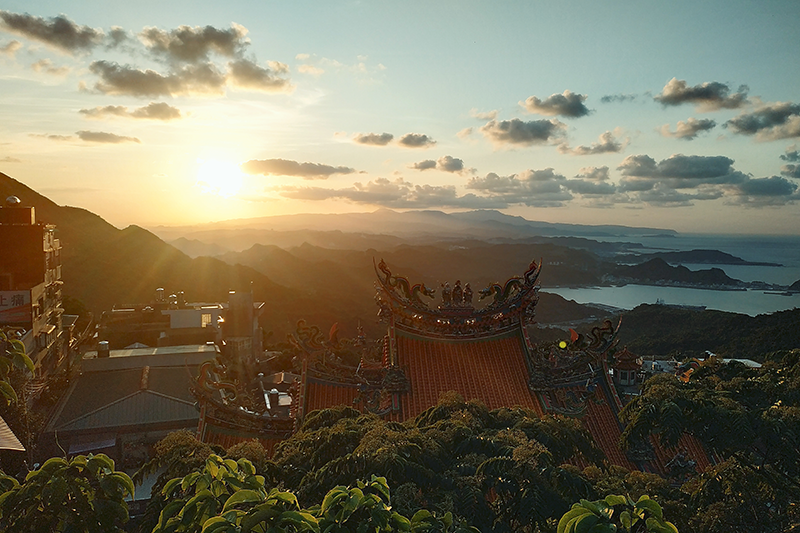
Jiufen Hilly Sightview
About Caffee – Shuinandong
The Ōgon Shrine – Jinguashi
Shin-Jin-Jiu Old Steet
Gold Museum Jinguashi
Jiufen Old Steet
Jiufen Old Steet
As we sift through the scattered fragments of those towns’ history and experience walking through their narrow streets, we find a hint of a hidden layer that is implied along with the long stories about gold and prosperity. It appears that instead of being developed organically, the transformation of identity, sociocultural characteristics, and even their ecological conditions tends to occur – directly and indirectly – due to the interference of “Strangers” who show up one after another in various forms. Ranging from gold mine companies, colonizers, artists, entrepreneurs, investors, or even the government, each of those figures has their own perspective to determine the value of Riufang district, as well as manages that hilly area based on their own specific goals and interests. On the other hand, though the dwellers seem helpless and trapped as spectators who keep struggling to survive, some also have a significant role as actors. Their ability to adapt to every transformation and persistence to preserve their daily culture eventually nourished those rural towns’ “Spirit of Place”. In other words, the “Strangers” and even the “Dwellers” take a role in determining the space’s identity and even change it into another identity based on their particular interest, as well as the figure who chooses to don’t take action and just follows their living space transformation became valuable things that emphasize the whole story of Riufang hilly area.
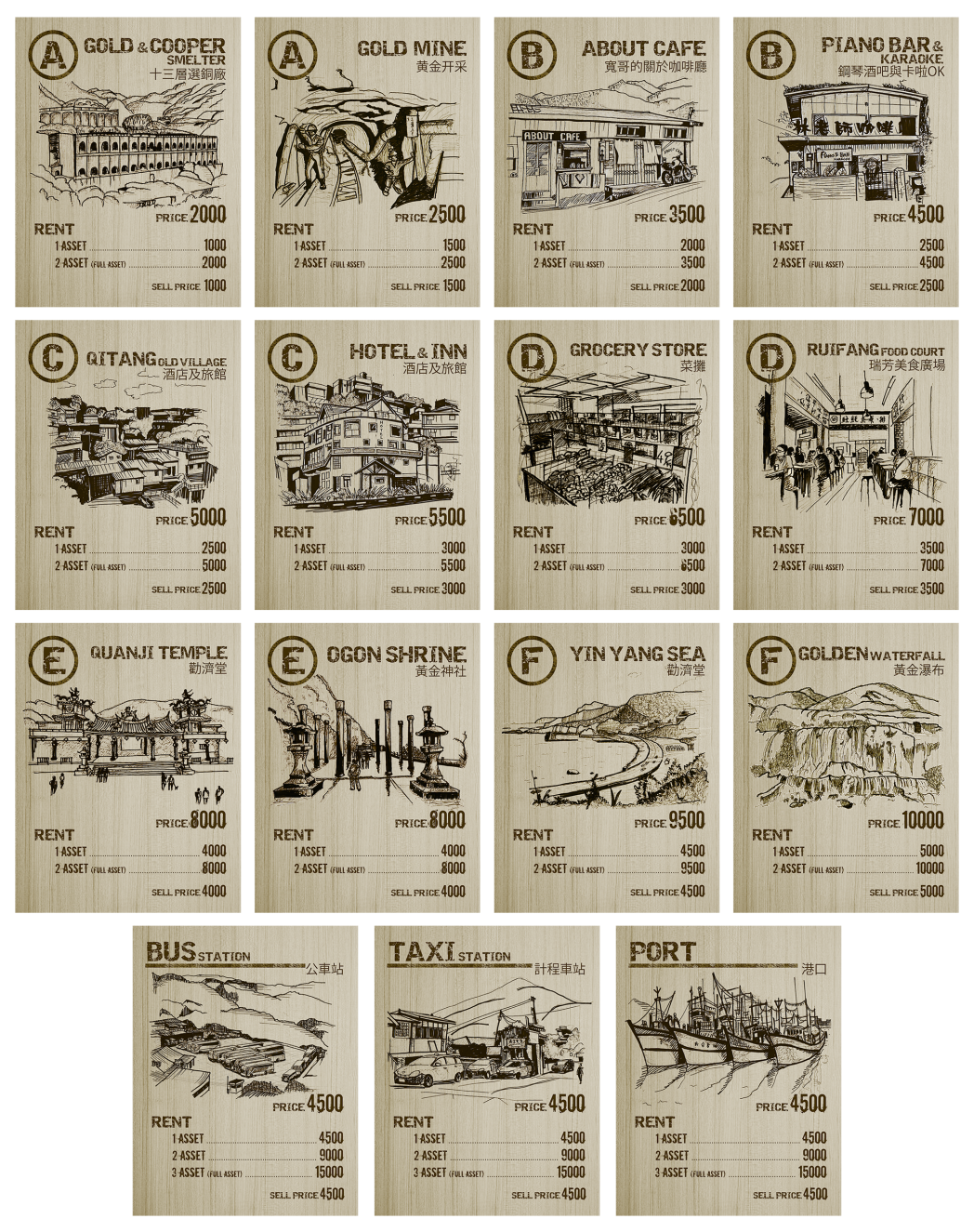
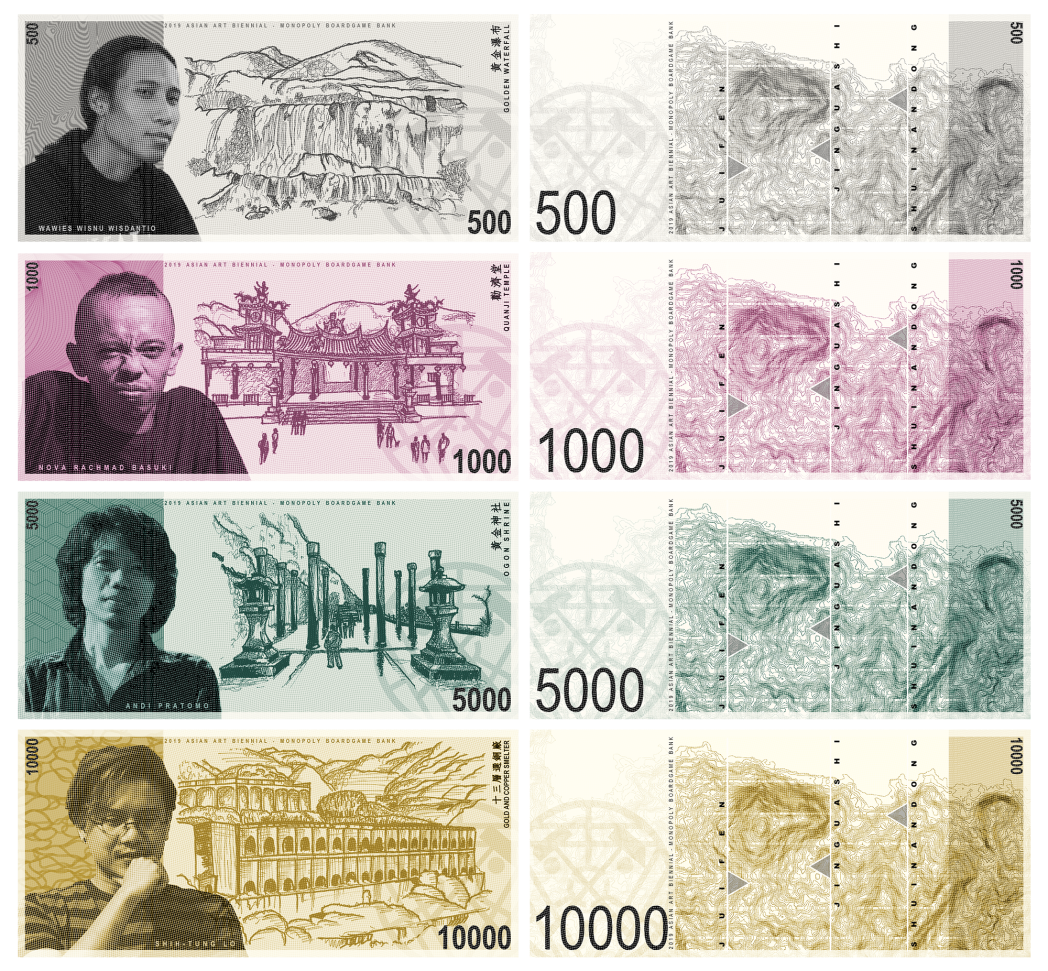
The tendency that the significant role of “Strangers” or even the “Dwellers” get buried as a hidden layer overshadowed by nostalgic narratives of prosperity and despair drives our interest to re-enact those Strangers’ contributions as narrations fragments that shaped the whole history of Shuinandong – Jingashi – Juifen. Instead of representing it in the form of a historical narrative full of dates, names, and even complex historical event notes, which tend to be monotonous and sometimes less engaging storytelling process, the narratives of how the “Stranger” can determine the space’s identity and even can change it into another identity is presented side by side with Riufang Hill’s history in the form of an interactive role-playing game installation as if a monopoly board game. Driven by this idea, under collaboration work with Nova Rachmad Basuki (Nopel), we created “Delirious LandLord” as an interactive installation based on the classic Monopoly board game.
“Delirious LandLord” is a customized Monopoly board game that delivers its player on a captivating virtual journey through various places spread across the Riufang hilly area. As if playing the classic Monopoly board game, focusing on buying, trading, and developing properties. The main objective of The Delirious Landlord is to try to deliver its players a deeper understanding of how their role as a “Stranger” understand each place’s in-game identity and how they can determine their act while defining each place as a property. Meanwhile, at the same time, the players can also learn that their activities area resemble the historical significance of the Strangers and how their act can have an impact towards the Riufang hilly area and its society in the real event.
“Delirious LandLord” display video – “Deposits Of The Island” – Asian Art Biennale 2019 “The stranger from the mountains and the sea”
Video by Nova Rachmad Basuki (Nopel) (Lifepatch)
“Delirious Landlord Property Cards” Design by “Wawies” Wisnu Wisdantio, Sketches by Andi Pratomo
The identity of an area and how it changes into another identity often occurs because of some people’s interest.
Similar to the way when playing a property board game called the Monopoly game.
Not just driven the ecological changes, it also impacts the dweller’s way of life.
They are forced to adapt in order to survive in every condition.
However, will they choose to take the role of audiences and float within the flow of the game?
Or will they choose to take the role an actor who can influence and determine their own identity in the future?
What about you?
___________________________________________
Delirious Landlord within “Deposits Of The Island” exhibition on Asian Art Biennale 2019 “The stranger from the mountains and the sea” – Artist Talk Video
A representation of Hans Christoffel’s past stories and his ghostly memories (2017)
___________________________________________
“Lucid Memories” is a series of Pepper’s Ghost Projection installations that were built as part of the Lifepatch projects and exhibited in two different cities in Belgium. The first project is a Lifepatch solo exhibition titled “IN SITU: Lifepatch – The Tale Of Tiger And Lion” in Museum van Hedendaagse Kunst Antwerpen (M HKA) from 16 September 2017 until 7 January 2018, curated by Nav Haq and Alia Swastika. The second project is an exhibition titled “Tano Toba Saga” under the grand exhibition of “Europalia Art Festival Indonesia – 2017” with the main title called “Power and other things: Indonesia & Art (1835-now)” curated by Charles Esche and Riksa Afiaty in Palais des Beaux-Arts (BOZAR), Brussels, from 18 October 2017 until 21 January 2018.
Both projects focused on presenting the two key figures and their relations within a small fragment of the North Sumatra long histories during the colonial era, which are Sisingamangaraja XII, as the last king of the Toba People and the Swiss-Dutch soldier Hans Christoffel, who represents the Dutch empire with their colonisation policies. It begins with an opportunity for Lifepatch to conduct brief research through various well-preserved Indonesian historical artefacts, narrations, and documents that are well-preserved in the Museum Aan De Stroom at Antwerp and Bronbeek Museum at Arnhem, likewise the exploration through various places in North Sumatra that local histories are mostly delivered orally and culturally as storytelling, theatre, song or even dance. Driven by the tendencies that history often articulated into several versions motivated by the perspective of ideology, politics, and even personal identity, instead of intending to summarize the long history of colonialism in North Sumatra and comparing each version to find the most proper version, through both projects, Lifepatch tried to present all the scattered historical fragments and its contrast attributes to emphasize its complexity through incorporating historical artwork and archival material, together with a major narration linking all the installations.
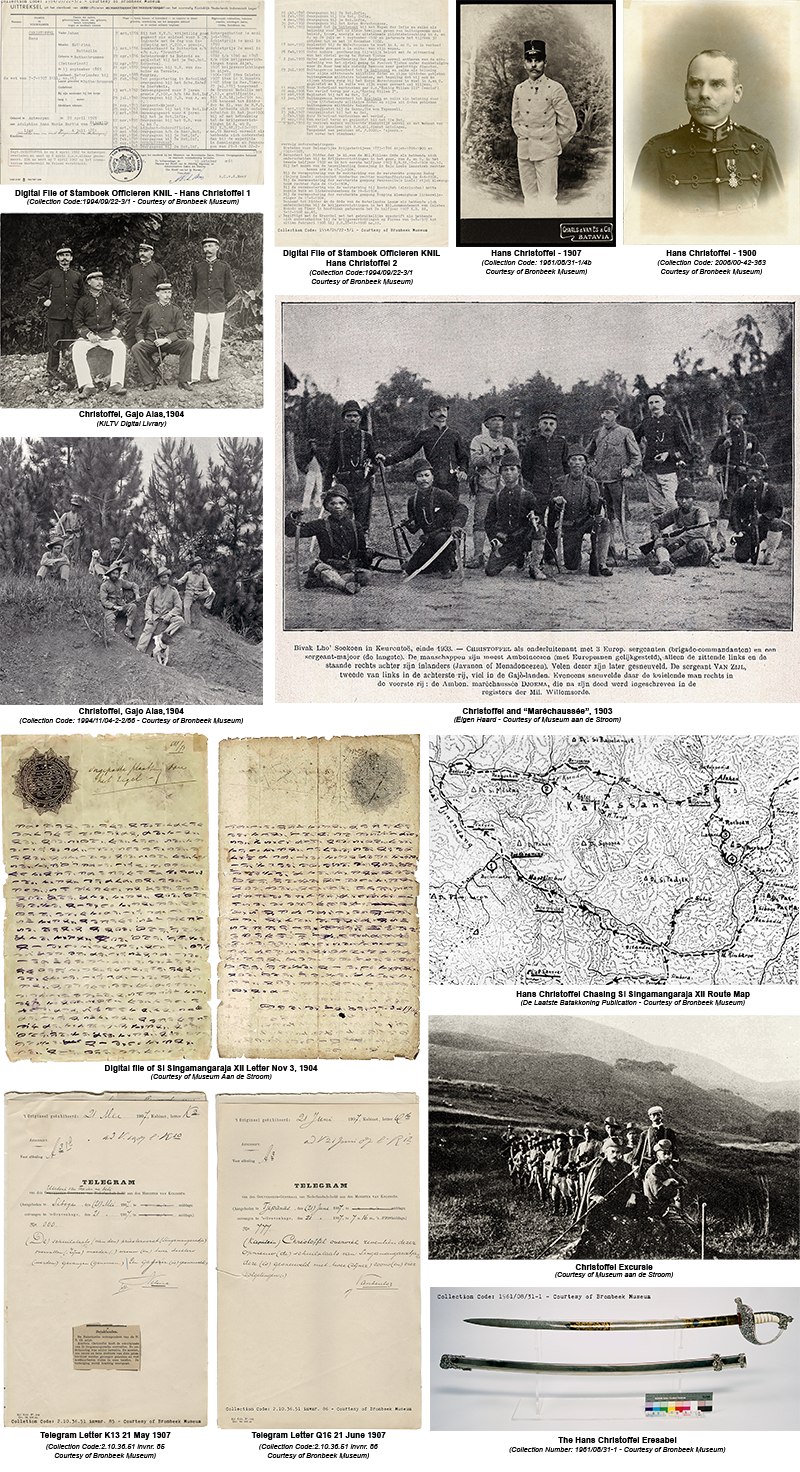
Those ideas brought me as part of Lifepatch have an interest in presenting a historical narration focused on Hans Christoffel’s figure, whose existence has become an inseparable part of North Sumatra’s history during the colonial era. The tendencies of history that are strongly influenced by certain perspectives and identities brought the story of Hans Christoffel to have several slightly different versions, not just the fact that he was a “Koninklijk Nederlands Indisch Leger” (KNIL) officer who succeeded in leading many military operations during the pacification of East Indische as the Dutch colony territory, including the obliteration of Toba people guerrilla resistance in the Tapanoeli war by capturing their leader the Si Singamangaraja XII who eventually died on a battlefront. For some people, he would be defined as an evil person based on his bloodstained reputation, who prefers to assault his prey and finish the kill without mercy. On the other side, some people would prefer to acknowledge him as a great soldier or a hero because of his achievements. Meanwhile, as we explore the archives during the research as part of a residency program fully supported by Museum van Hedendaagse Kunst Antwerpen (M HKA), AIR Antwerpen, each well-preserved artefacts and documents such as military log-book, pictures, telegrams, letters, postcards, newspaper clippings within the museum archives seems to hide a particular story with a specific context, time periods and space that can be interpreted as scattered fragments of a bigger story. Eventually, the linkage of each material weaves a fairly long story that can be divided into four main chapters, which were the chapter about Christoffel’s military career during his services as an officer in the Royal Dutch East Indische Army, the chapter about his iconic military missions in North Sumatra when obliterating the Toba People resistance and captures their leader Si Singamangaraja XII, the chapter about his military achievement during the pacification of Dutch East Indische that brought him became one of the highly decorated soldiers and ended with his daily life after retired story as the final chapter.
However, while compiling Christoffel’s story, I met with a strange situation that sparked my curiosity. Although he was a person with great military achievement, received a knight title, and was awarded the Eresabel sabre as one of the highest military awards for bravery in the Netherlands Kingdom, there are only a few artefacts or documents that could represent his story. Even in the Bronbeek Museum, that prided itself as the central archive for preserving the Royal Dutch East Indische Army histories during the colonial era, its collection only presents Christoffel’s figure through several official military documents, old pictures, and his Eresabel.
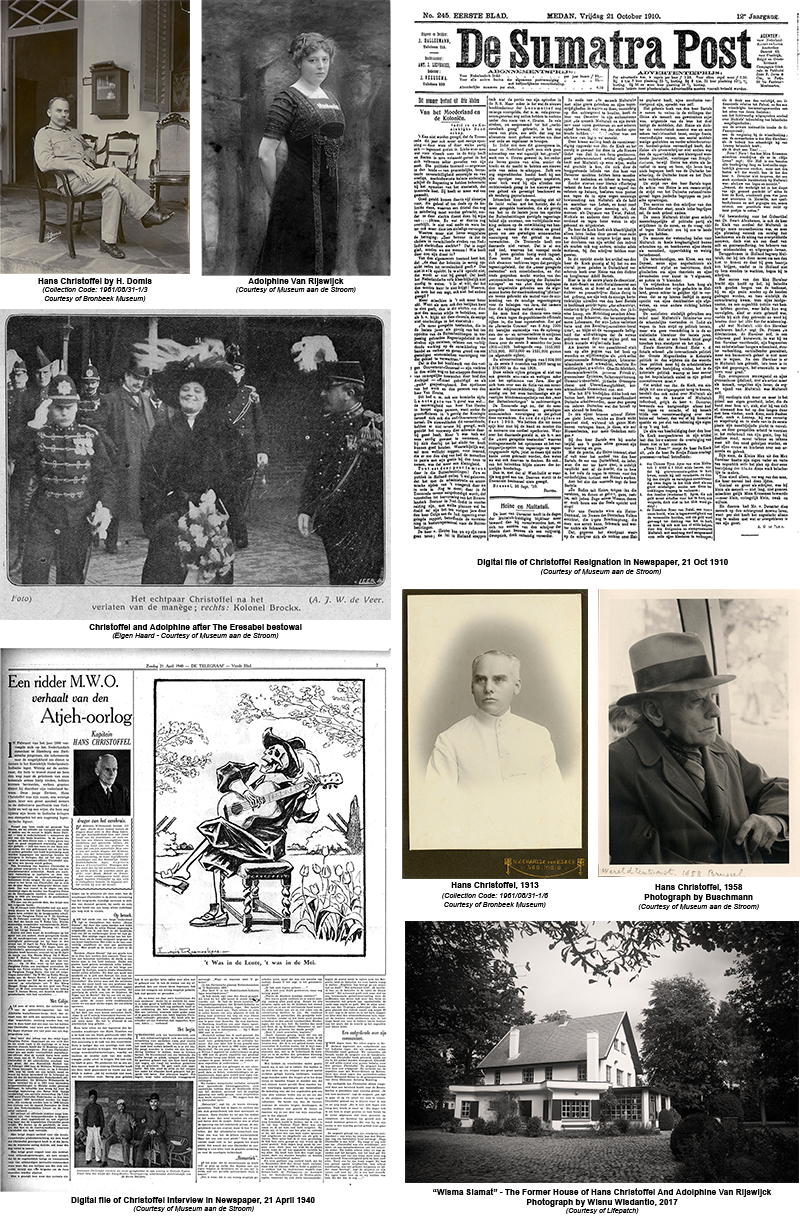
Through the opportunities to have great discussions with Willy Durinx -Co-Curator “Collectie Christoffel” of Museum Aan De Stroom- who also allowed me to see some of his research, I learn many other interesting facts about Hans Christoffel based on information that preserved in a digital scan of several newspaper articles, few of Christoffel personal portrait picture, and buildings in around Antwerp and Kalmthout, Belgium.
The most interesting facts about Christoffel during his retirement days are well-preserved in an interview article within a newspaper called De Telegraaf that was published on 21 April 1940. It shows that he seems to try very hard to change his persona completely.
“I have done my duty in Indië, but nothing else. And it’s all so terribly long ago…”
…………
“Thirty years ago, I dropped a curtain about everything that had happened. I shook off all my time in the jungle, started a new life, thought about the past as little as possible, searched for and found peace.
(Christoffel, De Telegraaf, 21 April 1940)
“With the history where everybody else would be happy to boast about, Christoffel has completely broken with it. He has burned all things from his Indischen time, reports, letters, pictures….”
(Article Writer, De Telegraaf, 21 April 1940)
It appears that to cover his deeply rooted and emotionally related memories, he needs more effort than just alienating his past life by changing his daily activities with a totally different way of life. He also implants a new thought that what he had done in the past was merely carrying out his duties as a soldier, no less and no more. Even though he has to complete the assignments using methods that are considered to be vile and without mercy, he admits that “It was a messy job, but it has to be done”. Finally, to prevent his past life from being remembered, he burned all his personal notebooks, photographs, and various documents that could work as a powerful stimulus to reenact the feelings and experiences of the past.
Compared to what Lifepatch learned from the Toba people in North Sumatra, they believe that memories of the past are very important things and must always be preserved as part of efforts to maintain their personal and community identities. Even though they no longer possess their own rightful heirloom and historical artefact because thousands of weapons, jewelry, textiles, and many other cultural objects had been taken from the battlefield, “donated under pressure” or just bought during the colonial era, the Toba people have their own way to preserve their history and delivering it to the next generations orally and culturally through storytelling, theatre, song or even dance.
Both of them appear to emphasise the fact that memory is an absolute necessity for the existence of history. At the same time, their memories manifested as a story that provides additional value to particular objects and makes them could be considered to be a treasure or historical artefact. Even though memory constantly requires objects or maybe particular keywords to recall back in our minds, the past can still exist in people’s heads and nowhere else. Just like what I learned from Christoffel’s answers during the interview with De Telegraaf. His efforts to cover up the past and make it no longer able to be remembered might be considered successful. Can’t be denied, his actions not only affect him personally but also make his past very difficult to reunite and retold accurately by anyone else. At the same time, how the way he refused to answer the questions by changing the conversation subject to his current life story seems to have a tendency that actually Christoffel’s subconscious mind still stored some traces of his past, even though it can’t be easy to remember. Those memories keep waiting as a non-figurative entity, haunting him with the possibility that they could reappear clearly in his mind when he encounters certain things or a particular object. It will be revealed in our mind as several major pieces of information in the form of illusory images, which are assembled sequentially by our thoughts into a story with its own reality, as if a transparent ghostly figure.
The phantasmagoria values of memories brought me to have an interest in the idea of presenting Christoffel’s past story narrations in the form of a non-figurative entity, instead of presenting various historical artefacts in their original physical form. All of the artefacts were scanned and processed digitally to generate a series of imaginary objects as materials to produce animated videos. Through those videos, I tried to anthropomorphise them as if they were alive and kept trying to tell Christoffel’s memories that are still preserved until now.
In the end, those animated videos will be presented with illusion techniques that were discovered around the 16th century and popularised by John Pepper around 1862 in the Phantasmagoria performances, so-called “Pepper’s Ghost“ technique. It’s a version of visual effects using glass and light to produce a reflection of a person or an object to appear on stage, similar to a ghost or a hollow entity.
Besides bringing back Christoffel’s past in a form of memory as non-figurative entities, the installation of Lucid Memories is also used as a medium to raise several questions about the existence of historic artefacts that are usually taken from their original place and then will be valued, preserved, even presented as physical evidence to verify the truth of certain historical or cultural narratives within museums or other facilities. It’s closely related to the existence of various heritages and historical artefacts belong to the Toba people. Instead of being stored, cared for, and culturally becoming part of their rightful owners’ daily lives, many of these artefacts are stored and well-preserved in various museums abroad. Ironically, it becomes part of exhibitions to tell or represent historical narratives, which are actually just a small fragment of a bigger story.
Risen up from those questions, although many technological advances have been made in the field of visual technology, the Lucid Memories was built as a prototype of simple technology to convert a video into three-dimensional illusory images of particular artefacts to present historical or cultural narrations that can be shown in various places. Meanwhile, the artefacts in their physical form will always be protected and preserved in their original places.
Produced as part of “Power And Other Things: Indonesia & Art (1835 – Now)” Europalia Art Festival Indonesia 2017. Exhibited at the Palais des Beaux-Arts (BOZAR) in Brussels and Museum van Hedendaagse Kunst Antwerpen (M HKA) in Antwerp, Belgium.
The Design of Installation about the historical narrations complexity and contradiction of a small fragment within Toba Land long history during the colonial era that has been told or documented
(2017)
___________________________________________
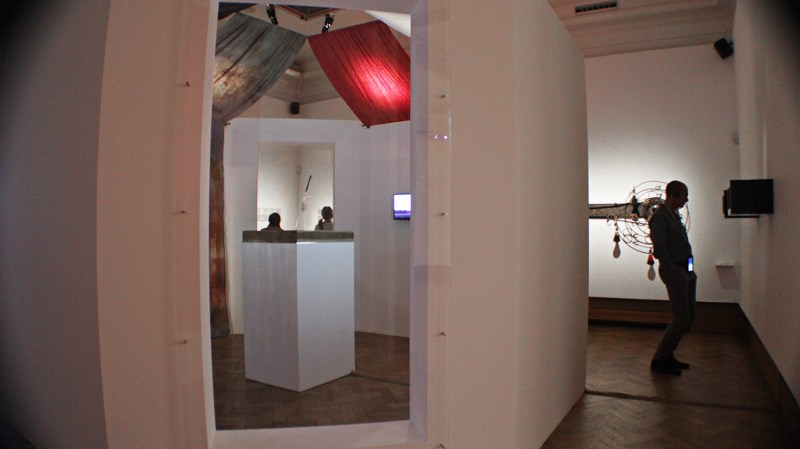
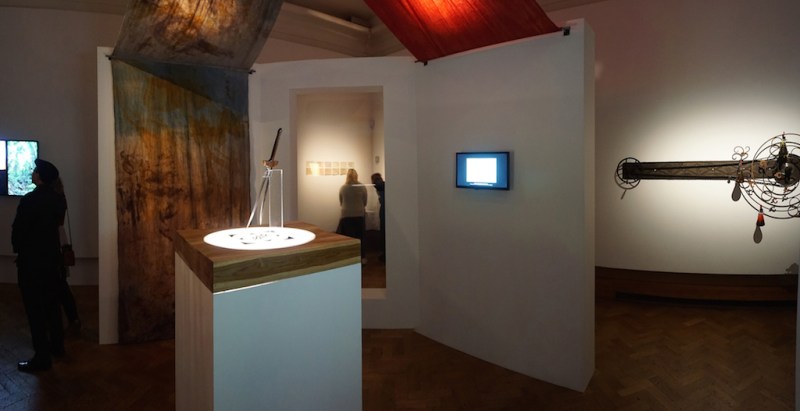
The Tano Toba Saga installation or exhibition design was made for the Lifepatch exhibition as part of the “Power And Other Things: Indonesia & Art (1835 – Now)” under the framework of Europalia Art Festival Indonesia in Palais des Beaux-Arts (BOZAR) – Brussels at 18 October 2017 until 21 January 2018, curated by Riksa Afiaty and Charles Esche. It’s a series of installations depicting the stories of two key figures and their relations within a small fragment of the North Sumatera long histories during the colonial era, which are the Swiss-Dutch soldier Hans Christoffel and the last king of Toba people called Sisingamangaraja XII.
The Tano Toba Saga project begins with an opportunity for Lifepatch to make brief research through various well-preserved Indonesian historical artefacts at the Museum Aan de Stroom (MAS) Antwerp. It possesses thousands of collections from the Nederlands Indisch colonization era stretching out from weapons, jewelry, heirlooms, flags, documents, and old photos that many of them were grants from Hans Christoffel’s private collection. since too many to show, some of them curated to present the narrations about Sisingamangaraja XII and Toba people’s resistance towards the Dutch colonization in North Sumatra, along with the narration about Hans Christoffel who successfully ended the resistance during his services as the Koninklijk Nederlands Indisch Leger (KNIL) officer. At the same time, we also got an opportunity to learn about both of the two key figures from the artefacts collection at Bronbeek Museum at Arnhem, which is the Koninklijk Nederlands Indisch Leger (KNIL) main archive to keep their histories during the East Indies colonization era.
Witnessing thousands of artefacts including irreplaceable historical heirlooms that are directly related to the Sisingamangaraja XII and Toba People’s resistance being stored and valued to construct or verified historical narrations far from its origins, brought Lifepatch to conduct further research in various places at North Sumatra, such as Medan, Balige, Bakkara, Parlilitan, Pangururan, and many more places. During the exploration, we found that even though they didn’t possess their rightful historical heirlooms and being oppressed culturally and politically by the colonial government, the Toba people still believe and preserve their histories through generations. Slightly different from the structure of Western knowledge in that history tends to be conveyed in a linear fashion and facts are generally collected based on written sources and the existence of historical objects as physical proof, The history and knowledge in Indonesia is produced and delivered orally and culturally through storytelling, theatre, song or even dance. Sifting through those scattered materials in North Sumatra, we begin to gather fragments of stories based on the Toba people’s side of view about Sisingamangaraja XII, the people’s resistance against the Dutch, Hans Christoffel, the connection between colonialism and evangelism, and the myths that accompanied the Batak war stories.
Working with those artefacts, materials, and narrations, there are tendencies that the histories depicted and often articulated into several versions motivated by the perspective of ideology, politics, and even personal identity. It appears that the “truth” is slightly different between the conflict “winners” version and the Toba people version. However, instead of intending to summarize the long history of colonialism in North Sumatra and comparing each version to find the most proper version, Lifepatch presents the scattered historical fragments and their contrasting attributes to bring up the complexity of history. Furthermore, driven by their pride as a collective-based community with collaboration and interdisciplinary between its members as their works’ core, The Tano Toba Saga is presented by incorporating historical artwork installations and archival material, together with a major narration linking all the exhibits. As part of Lifepatch, I was given the challenge of designing an exhibition layout as a physical element to emphasize the Tano Toba Saga major narration. Besides that, I was also presenting the Hans Christoffel ghostly memories through an Installation called “The Lucid Memories“.
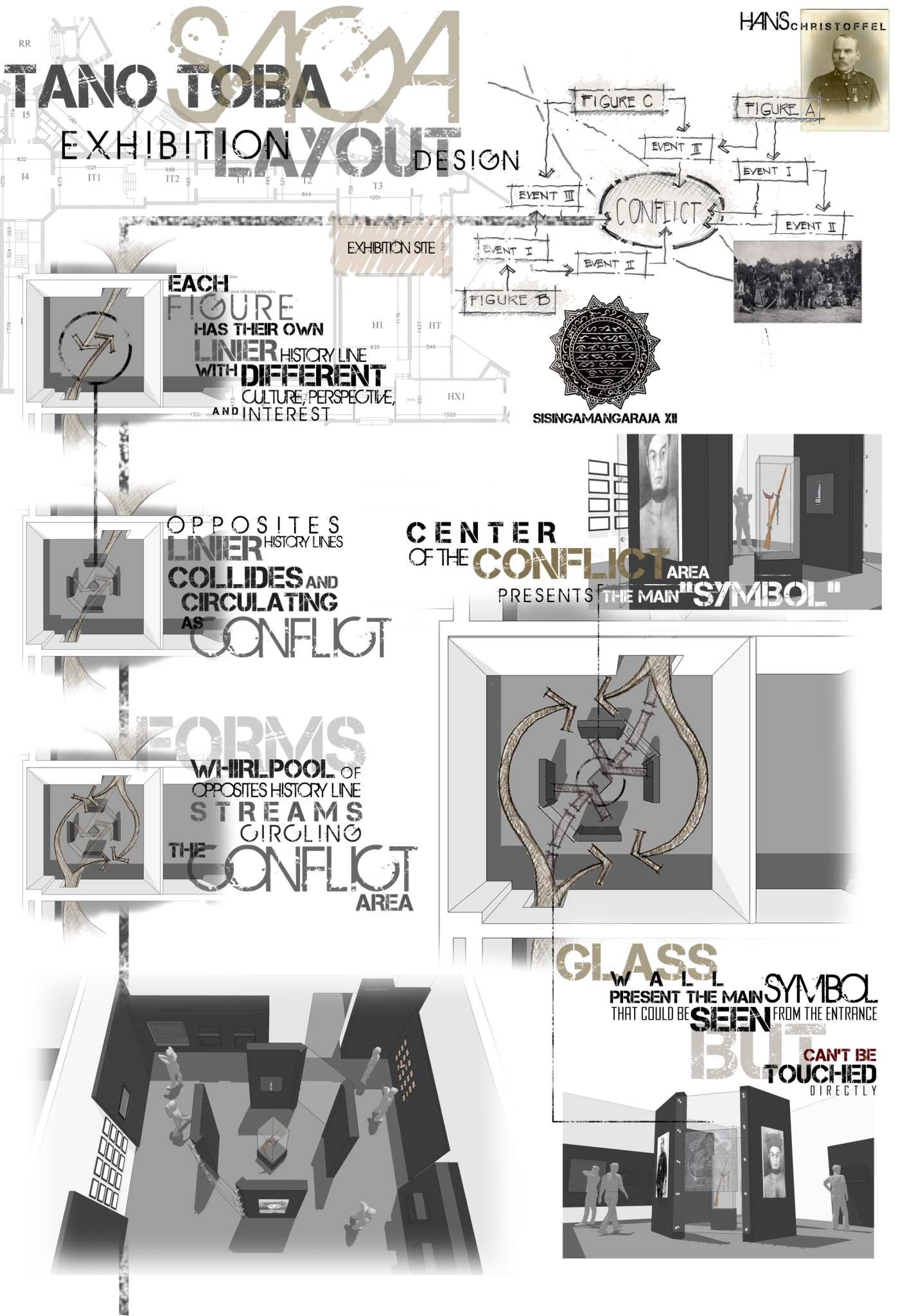
Drowning into the stream of history, I’ve been struggling to understand its complexity which seems always spinning and confusing similar to a maze or a labyrinth. Isn’t just motivated by its contradiction because of the “perspective of view”, the North Sumatra conflict is also a result of connectivity or causality between two or more linear progression lines that each line has its own causality sequence, which is “this happened, and then that happened; that happened because this happened first”. Within this case, both Hans Christoffel and Sisingamangaraja XII as the two key figures have their own history line with totally different attributes, such as cultural background, political interest, and so on. Sisingamangaraja XII is the King and religious leader of the Toba People who lived in North Sumatra. On the opposite, Hans Christoffel is a soldier who serves under the Koninklijk Nederlandsch-Indische Leger (Netherlands Royal Army) or KNIL. It was a military force that was formed to protect the Dutch interests when expanding their colony’s territories and maintaining their colonial rule in the Dutch East Indies. However, driven by the Dutch Kingdom policies around the early 19th century to bring a conducive atmosphere for economic interest in the East Indische archipelago as their colonization region through unification and pacification, Hans Christoffel as part of the KNIL has to collide with Toba people’s resistance lead by Sisingamangaraja XII at a long-term war so-called the Tapanoeli War. It’s a conflict that occurred for up to 29 years and ended after the death of Sisingamangaraja during his guerrilla resistance.
Talking about the key figures and their connections, there seems a tendency that Causality as an orderly sequence of the “cause and effect” within a linear progression line plays a vital role in the Toba Saga exhibition layout design. Spatially, each key figure’s narration is described as like a water stream that flows in opposite directions from a different entry point. The first stream focused on the narrations of the Toba people before the Dutch arrival and afterward. The opposites stream presents the Hans Christoffel narrations as the Dutch and their policies of colonization representation. Flows through the exhibition room edges, both of the narration streams collide and create swirling flows at the center that are similar to the phenomenon of whirlpools as the conflict analogy. The whirlpool that continuously flows in circular direction flows seems to bring an effect that both of the cause and effect became overlapping each other and blur the details of its individual narratives differences, making it easy to interpret or defined differently from various perspectives.
Looking back on the entire research, it revealed that the Tapanoeli war and its complex attributes have a bigger contribution to work as an ambient background and affect the whole process. Its complexity becomes the main reason for questioning the truth and brought us to learn every past narration before the conflict happens and what things that might be causing it. At the same time, it also drove our thought when trying to understand how the conflict plays its part either spiritually or physically forming the North Sumatra people’s way of life in the present. Through this, it reveals the idea that the Tapanoeli war has deeper values rather than only being placed as physical historical archives to present stories about the great historical conflict in North Sumatra during the colonial era. It has an ability or functions as a ghostly imagining that is able to transcend time and space when describing the North Sumatra people’s identity and their way to talk about the past, present, and even the future.
Interested to represent the conflict unseen values as the ghostly imagining, I wanted to use the main vortex spatial design to carry the symbolism. The circular wall as the whirlpool accentuation engineered with a glass wall on the part that is directly facing the entrance, in order to bring the conflict vortex could be visually accessible from the entry door. The idea is to introduce the viewer to one of many conflicts during the colonial era in North Sumatra as the exhibition’s main issues and ignite their curiosity about it since they entered the exhibition room. Since it can’t be physically accessed directly, the viewer is forced to walk into the flow of the narration stream and learn the historical narration from a particular perspective before finally reaching the inner vortex. Furthermore, when walking out from the vortex through the opposite stream, the viewer will get a chance to learn the other perspective as a comparison to the former knowledge they already earn or memorized.
Cel animation on the Pepper Ghost holographic projection (2017)
___________________________________________
The Ghost Lamp is a small project that implements two different visual technics, which is a combination of the animation made with an adaptation of Cel Animation Methods and the Pepper Ghost Holographic Projection as the visualization method.
Cel Animation is a Traditional animation technique that has a similar way to flipbook animation works. It’s an old technique that displays a series of drawings slightly different from one to another image simultaneously at a fast speed, which is the rapid changes between each image that will create an illusion of movement.
Meanwhile, in order to create the animation as a ghostly image, the Cel animation will be projected with a Pepper’s Ghost Illusion projector. The Pepper Ghost holographic projection is an illusion effects technique for creating transparent ghostly images based on a 16th-century illusion technique in the Italian Peninsula that was re-discovered in around 1862 by Henry Dircks during the development of Dircksian Phantasmagoria, which was successfully implemented in the theatre performance by John Henry Pepper during the production of Charles Dickens’s “The Haunted Man” in 1862.
Based on the technique, the Ghost Face animation during this mini-experiment was created by combining hundreds of face picture sequences as a series of images from the static face expression until the face with a grinning smile image, which was displayed at around 10 Frame Per Second speed.
Image Series Sequences Within The Ghost Face Mini Project
The image was designed with high contrast between the figure and its black color background, in order to make the background part illuminated with low light intensity and the face part illuminated brightly as the only object or part that will be reflected or projected as the “Ghost”. Meanwhile, to build a story within the ghostly face appearance, the projection is designed to befall in the middle of an old lamp.
The Ghana Thinktank Residency Program On Climate Change And Environmental Issues Activism (2017)
___________________________________________
Ghana Thinktank (GTT) is an international collective that “develops the first world” by flipping traditional power dynamics, allowing the “third world” to intervene in the lives of the people living in the so-called “developed” world. They collect problems from communities throughout the USA and European countries. After that, they send the problems to their collaborator the so-called Thinktanks group in “developing” communities to generate its solutions. Nowadays, in order to achieve their goal, The Ghana Thinktank made a cooperation network that spread from Ghana, Cuba, El Salvador, Meksiko, Iran, Serbia, Indonesia, Sudan, Maroko, until India.
The Ghana Thinktank residency program on 11 – 27 March 2017 as part of The GTT Climate Change Project, a long year project as a collaboration between Ghana Thinktank with Williams College Museum of Art (WCMA) in Williamstown – Massachusetts. Slightly different from the former GTT projects, this is the GTT’s first effort to develop their ongoing projects in different approaches. Within this project, GTT and WCMA forming a “Student Action Team” to collect questions and problems of Berkshire citizens as their responses towards the project’s main question, “How does Climate Change affect YOU?”. Those problems were then sent to Morocco and Indonesia Thinktanks group to generate its solutions, which were also being invited to the United States to help implement their solutions. Within the residency program, Lifepatch as the Indonesian Thinktank was represented by me, “Timbil” Agus Tri Budiarto, and Agung “Geger” Firmanto. Meanwhile, the Moroccan ThinkTank was represented by Nadia Elaattar, Mariam Ait Oufkir, and Mehdi Ghinati.
The program itself divided became two main parts. The first half was located at the WCMA Rotunda as the site of Climate Change Project exhibition and the main workspace hub with the support of several Williams College facilities to conduct all activities focusing on the Thinktanks problem solution implementation in Williamstown.
Residency venues around Williams College – Williamstown
Williams College Museum of Art (WCMA), Williamstown, Berkshires, Massachusetts
Zhilkha Center For Environmental Inisiatives, Williams College
‘Whitmans’ Dining Hall, The Paresky Student Center, Williams College
Problem Cards And The Thinktank Solutions
Implementation of the Thinktank solutions after being discussed thoroughly with Ghana Thinktank, WCMA, and Student Action Team was manifested in some form of activities, Such as B.Y.O.C (Bring Your Own Cup) and Drink From the same vessel in the GTT Reception at WCMA Rotunda, Workshops in Zhilkha Center For Environmental Initiatives and The Paresky Student Center at Williams College, “Labeling And Meal Of The Future” action, and Lifepatch – River and environmental monitoring project at Jogja River Project Presentation at WCMA Rotunda.
Residency activities at around Williamstown and Williams College
Bring Your Own Cup (B.Y.O.C) in talk reception at WCMA Rotunda
Bring Your Own Cup (B.Y.O.C) in talk reception at WCMA Rotunda
Bring Your Own Cup (B.Y.O.C) in talk reception at WCMA Rotunda
Action Team, GTT, WCMA, And Thinktank Group discussion
Action Team, GTT, WCMA, And Thinktank Group discussion
Action Team, GTT, WCMA, And Thinktank Group discussion
Action Team, GTT, WCMA, And Thinktank Group discussion
Tempe Workshop at Zhilka Center Williams College
Tempe Workshop at Zhilka Center Williams College
Labeling And Meal Of The Future Action At Paresky Student Center – Courtesy of Augusta Rose Photo
Labeling And Meal Of The Future Action At Paresky Student Center – Courtesy of Augusta Rose Photo
Labeling And Meal Of The Future Action At Paresky Student Center – Courtesy of Augusta Rose Photo
Lifepatch – River and Environmental monitoring project in Jogja River Project at WCMA Rotunda – Courtesy of Augusta Rose Photo
Lifepatch – River and Environmental monitoring project in Jogja River Project at WCMA Rotunda – Courtesy of Augusta Rose Photo
Lifepatch – River and Environmental monitoring project in Jogja River Project at WCMA Rotunda
Besides that, there was a city public space intervention action as an implementation of the Thinktank solution about the driving habit in Williamstown.
To complete the solution from Morocco Thinktank group that suggested the Odometer intervention with a parking day (car-free day), I was promoted a cultural approach with “Mampir”, a Javanese culture habit that has tendencies to stop by, drift, come by, or pay a visit to a particular spot or doing a different activity on their way to reach their main destination. It’s a habit that makes the journey more meaningful rather than just reaching the destination in the fastest and most efficient way. Within this concept, there are several points so-called activities magnet that was chosen or made with different activities to attract people just to stop by and made different activities during their journey. The action that was held by the GTT, WCMA, and the student action team was made to intervene in the activities on Spring Street, the busiest commercial street in Williamstown.
Documentation of Parking Day/Odometer Freeze Action in Spring Street, Williamstown
Parking Day/Odometer Freeze Action in Spring Street, Williamstown – Courtesy of GTT and WCMA
Parking Day/Odometer Freeze Action in Spring Street, Williamstown – Courtesy of GTT and WCMA
Parking Day/Odometer Freeze Action in Spring Street, Williamstown – Courtesy of GTT and WCMA
Documentation of Parking Day/Odometer Freeze Action (Re-Capture from Facebook Live Video that was made by Nina Pelaez – Courtesy of Action Team, Ghana ThinkTank dan Williams College Museum Of Art)
The action itself also was documented and published in Berkshire local newspaper called Berkshire Eagle. The article itself also published on online news that could be accessed on www.berkshireeagle.com.
The last half of residency program was continued in Detroit city – Michigan and became part of the “American Riad” Project, a collaboration project between Ghana ThinkTank with The North End Woodward Community Organization (NEWCO), Oakland Avenue Artist Coalition (OAAC), North End – Oakland Avenue citizens and many more groups or organizations. Within the project, GTT formed a partnership with a think tank in Morocco to rebuild this corner through arts and culture focusing to rebuild the tradition at Oakland Avenue that rich with cultural history and the Black Arts that was hit by a huge wave of gentrification. This collaboration is conducted to formulate and design an affordable residential community model based on the richness of local art and culture, namely by composing an open space as a binder between three separate buildings into one unified territory and each building has interrelated functions, namely settlement and small business units.
Site for the American Riad – the vacant lot will become a courtyard linking homes and businesses
Within the American Riad Project on the residency program, Lifepatch took a role to make a simple water filtration system as rainwater catchment system support. Its one of the solutions for the water resources problem since the freshwater utility on the site had been cut off when the huge wave of gentrification happened at the North-End district. Besides of making the water filtration, Lifepatch also conducting small public workshops about how to make the simple water filtration with the citizens on around the American Riad neighborhood and also with people on the Affirming Love Ministries (ALM) Church.
Water Filtration Public Workshops
Workshop at the American Riad Site neighborhood
Workshop at the American Riad Site neighborhood
Workshop at the American Riad Site neighborhood
Workshop at the Affirming Love Ministries (ALM) Church
Workshop at the Affirming Love Ministries (ALM) Church
The making of Water Filtration System at American Riad community house
Water Filtration Design Sketch
The American Riad Community House Repairmen – Photo Courtesy by Ghana Thinktank
Making the Water Filtration Prototype and material quality testing – Photo Courtesy by Ghana Thinktank
The American Riad Community House Repairmen – Photo Courtesy by Ghana Thinktank
The American Riad Community House Repairmen – Photo Courtesy by Ghana Thinktank
Making the Water Filtration Prototype and material quality testing
Prototype of The Pepper’s Ghost Projector V.01.3 as a visual tool to display both holographic images and physical materials (2017)
___________________________________________
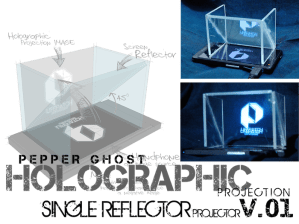
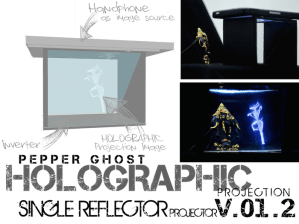
Pepper Ghost Holographic Projector With Single Reflector V.01.3 is the following up experiment of the Pepper’s Ghost holographic image projector with a single reflector Version V.01.1 and Version V.01.2, which are small experiments to make a simple projector tool for Pepper Ghost illusion that quite popular to use in various performance since successfully implemented by John Henry Pepper on the theatre performance during the production of Charles Dickens’s “The Haunted Man” in 1862.
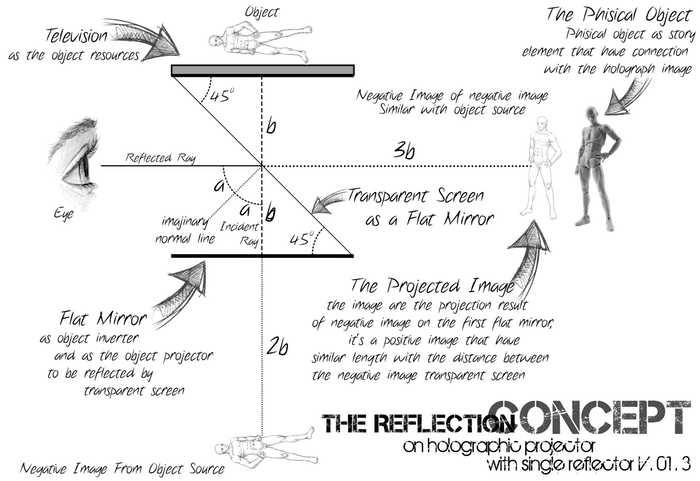
Reviewing the former experiments, the Pepper Ghost holographic projector V.01.1 is a model that is based on the basic law of reflection, which is creating a ghostly image as a reflection of an actual object on a transparent mirror. As a mirror image, the ghostly image is a negative or opposite direction from the actual object. Meanwhile, the Pepper Ghost holographic projector V.01.2 is the basic model for further development, which is successfully installing a simple image inverting mechanism that makes the ghostly image as same as the actual image. In a simple explanation, the image inverting mechanism is adding a flat mirror to reflect the actual object and create a negative image, which is to be reflected or appear in the 45-degree transparent sheet as a ghost illusion that is similar to the actual object or a positive image.
The Pepper Ghost Holographic Projector V.01.3 experiment is trying to develop a connection between the Pepper’s Ghost illusion and physical object. Based on notes from the V.01.2 experiment, the implementation of inverting mirror made the source image reflected twice caused an affect the final result, which is the accumulation of distance between the actual image, flat mirror and transparent reflector brought the ghostly image reflection equal with the distance accumulation and seems projected far behind the box.
Under this phenomenon, The Pepper Ghost Holographic Projector V.01.3 experiment is focusing on building a compartment to support the connection between the illusion image and the physical object, which is more into the measurement of the projection image result distance from the 45-degree clear screen as a point to determine the location of physical object base on its value, such as became the foreground, the background, or became at the same level with the holographic projection result.
The concept became based on designing and developing the Pepper’s Ghost Holographic Projector With Single Reflector V.01.3 model. Furthermore, some ideas also determined the projector design, such as:
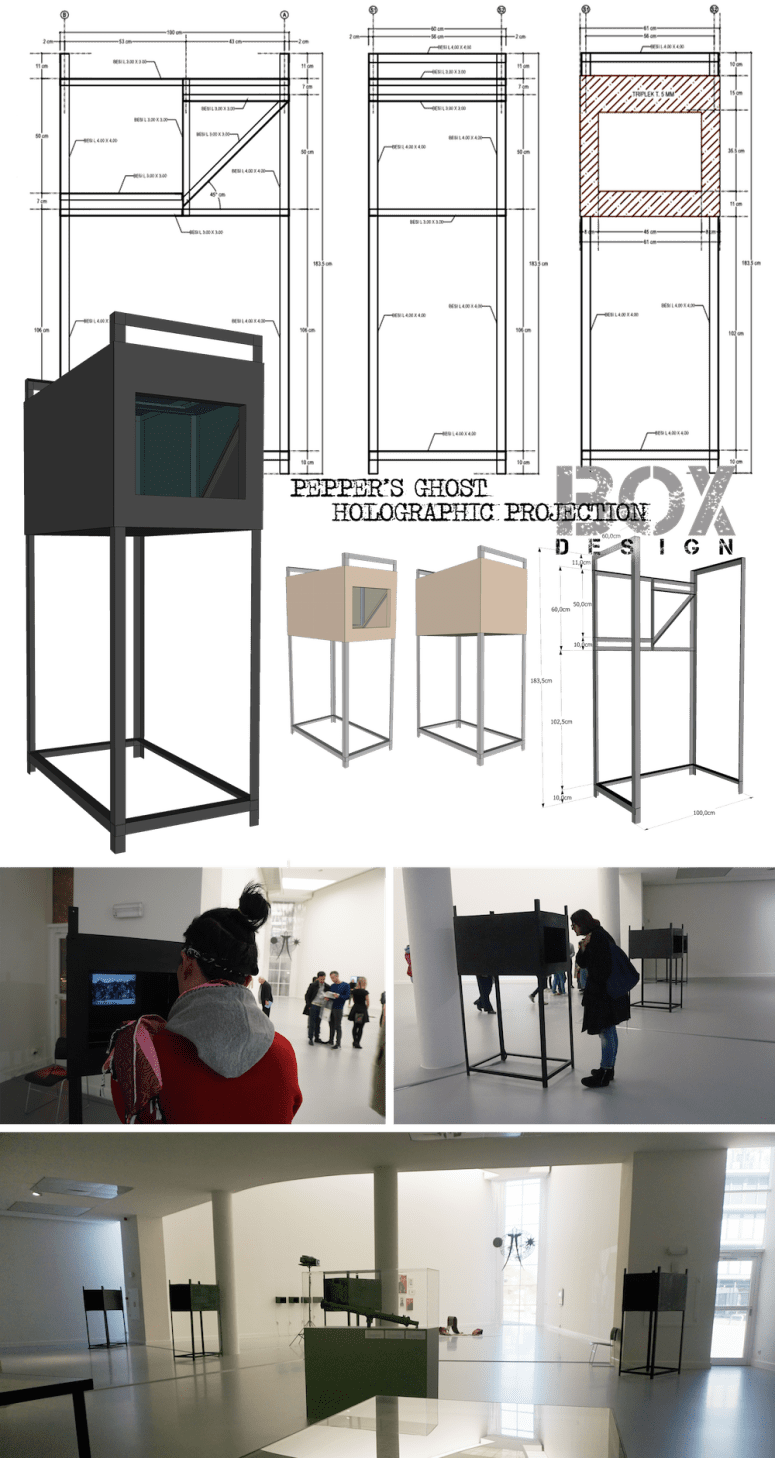
The Pepper’s Ghost Holographic Projector With Single Reflector V.01.3 model was designed as a wooden box that has 2 compartments, which are the illusion mechanism compartment and the holographic projection with the physical object compartment.
The illusion mechanism compartment is the place where the image source device is hidden and reflected through both the flat mirror and the transparent mirror. During the experiment, a 17″ television is chosen as the image source under the hypothesis that the device is a common electronic tool that could be found easily in almost every household and it has medium-sized that still could be easy to hide within the Pepper Ghost V.01.3 Box.
The projection compartment is the place where the animated image illusion will appear with the physical object. Within the experiment, the compartment of pepper ghost illusion will be designed to support a medium-sized object that could be found easily in every household, which has approximately 30 – 40 cm tall or have a similar size to the tall or height of the image source.
During the test of Pepper’s Ghost Holographic Projector V.01.3, an animated video will be played simultaneously on the 17″ television that is hidden in a small image source compartment to be reflected or projected by both of flat mirror and a diagonal transparent sheet to the physical object compartment that already placed an old Storm Lamp. The connection between the animated video as “the ghost” and the old lamp as a physical object is arranged to build the story with the title “The Ghost Lamp“
The result of the Pepper’s Ghost Holographic Projector With Single Reflector V.01.3 development
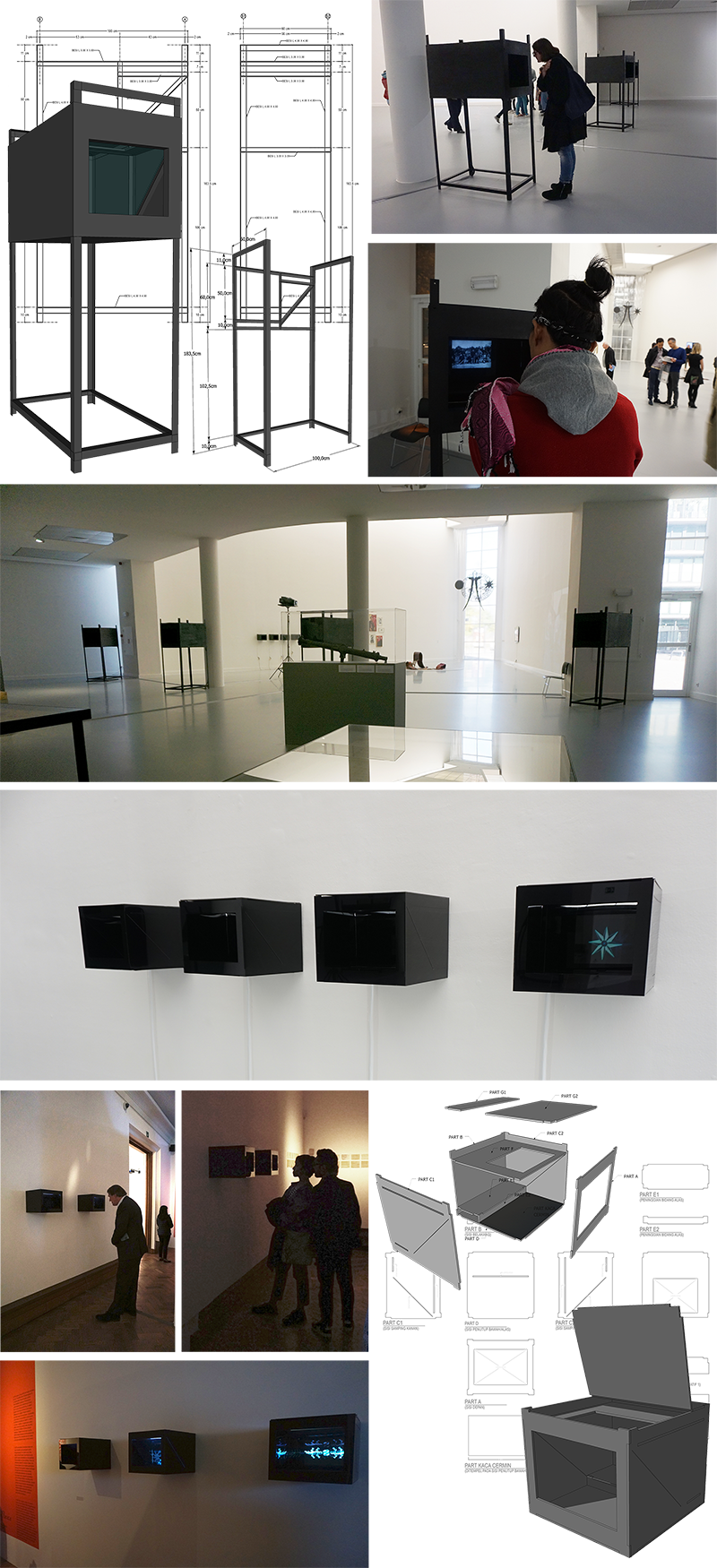
The first model was a V.01.3 enforced with a steel structure. The model was designed as a single object that could become both a stand-alone installation and part of a bigger exhibition concept. However, the structure’s main function wasn’t only to support the wooden box, it also became the box height adjustment to achieve the spectator’s eye level. Produced with help of Wiratmo Amin Nugroho, a craftsman and also a musician from Salatiga city, the model was supported with a knock-down system and designed as part of the Lifepatch exhibition with the title “IN SITU: Lifepatch – The Tale Of Tiger And Lion” in Museum van Hedendaagse Kunst Antwerpen (M HKA) – Antwerp at 16 September 2017 until 7 January 2018.
The second model was a mini V.01.3. The model was designed for a tablet computer with a 10″ display size as the source image or object. Produced with help of the Pro-Studio, an acrylic cutting laser small company in Yogyakarta, the mini V.01.3 was built with 3 mm thick acrylic combined with a 1,5 mm flat mirror as the image inverter and 3/4 mm plexiglass as the transparent sheet reflector.
The Design of Installation about the collective community organic space based on compromisation and collaboration activities (2016)
___________________________________________
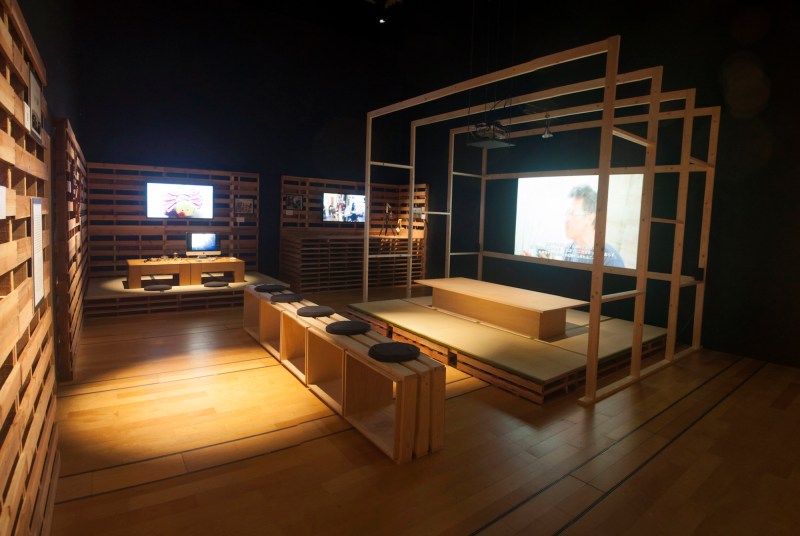
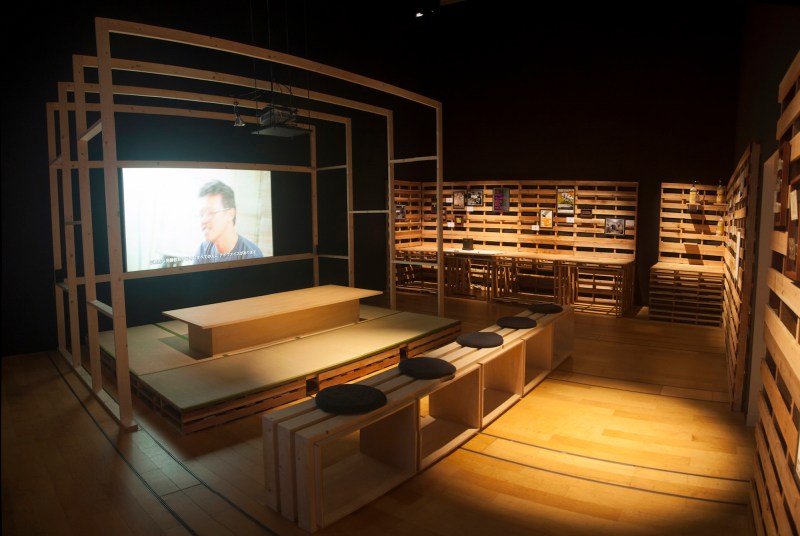
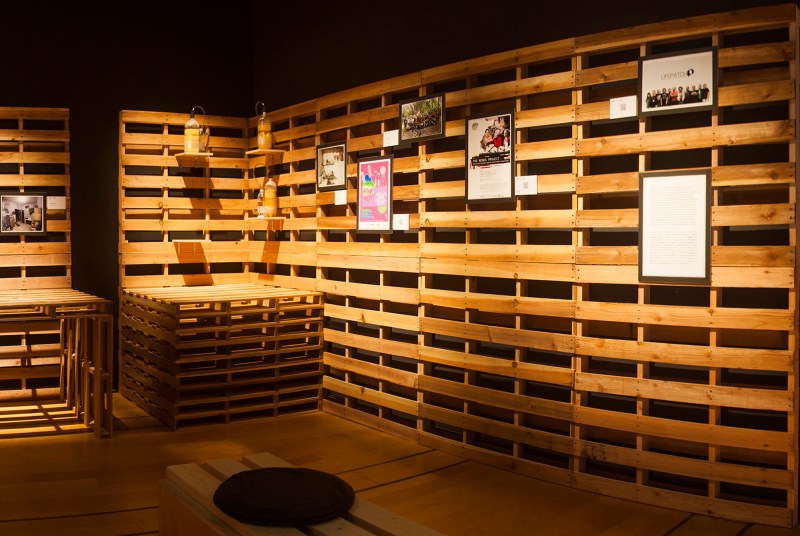
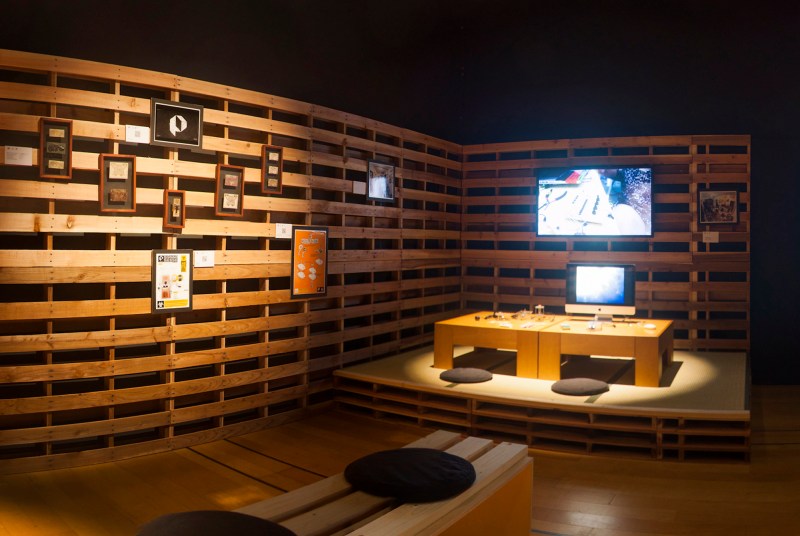
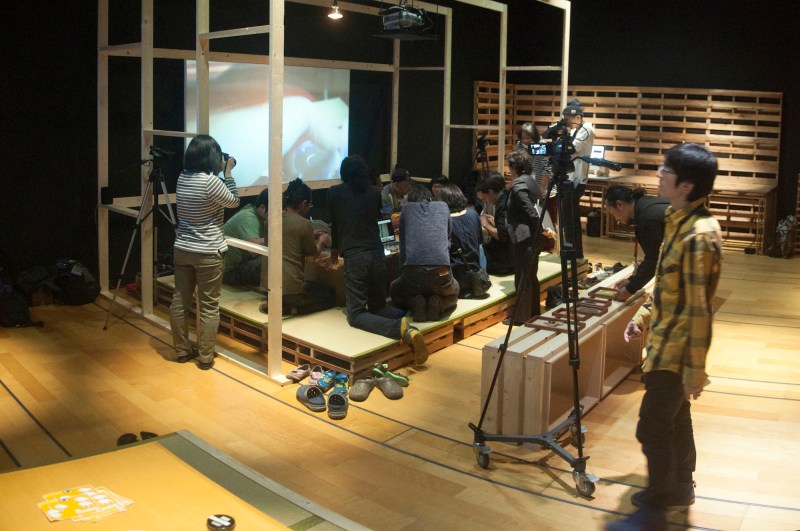
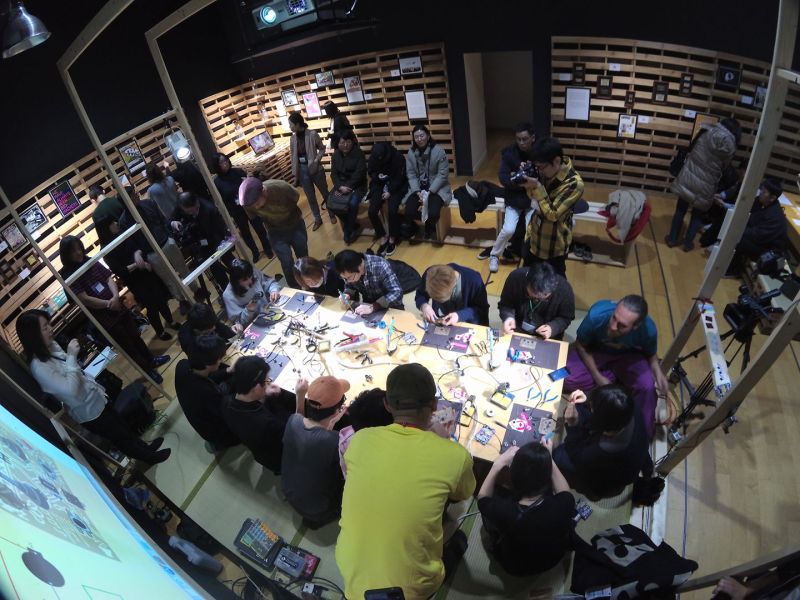
The Collaboration Projects “Media Conscious” in Asia: Lifepatch ‘Rumah and Halaman’ is activities and installation exhibition at the end 2016 until early 2017 organized by Japan Foundation Asia Center and NTT InterCommunication Center [ICC] and held at ICC Gallery B5, Tokyo Opera City Tower, Shinjuku-ku, Tokyo. Within this project, The ideas of the installation and exhibition design were to talk about The Lifepatch and all its works as a collective that formed in 2012 in Yogyakarta – Indonesia. The things that closely related to all my experiences as a member of The Lifepatch.
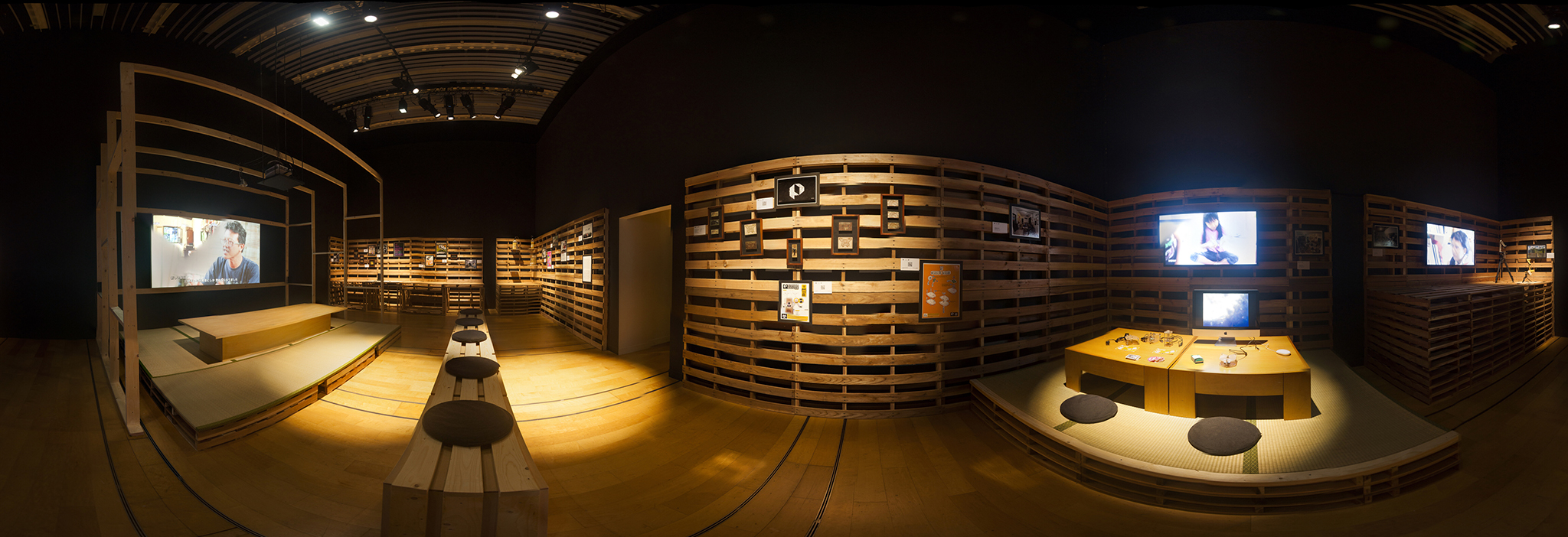
The Exhibition Installation of Collaboration Project ‘‘Media Conscious in Asia”: Lifepatch ‘Rumah dan Halaman’
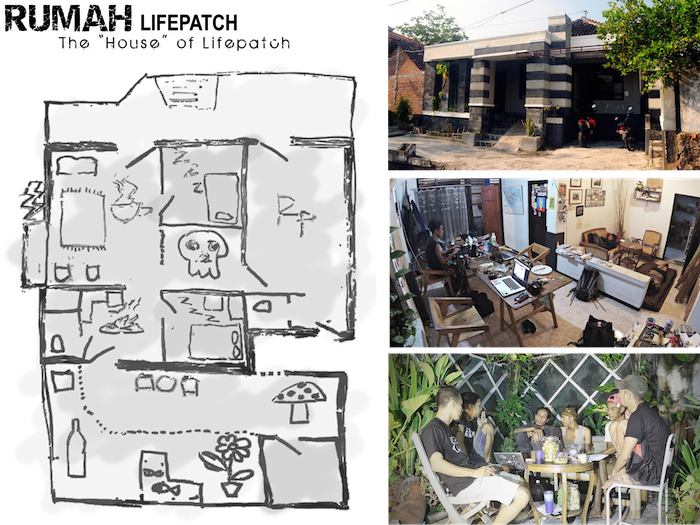
The Lifepatch is a collective community-based that has members with diverse interests and educational backgrounds, such as scientists, programmers, designers, artists, and curators. Since formed in Yogyakarta in 2012, they established a small house as their main place for works, conducts collaborative activities, and develops socially engaged projects related to art, science, and technology based on Do-It-Yourself (DIY) and Do-It-With-Others (DIWO) ethos. The place itself became an important space as a hub for individuals and communities to interact cooperatively through mutual learning, discussion, and meeting.
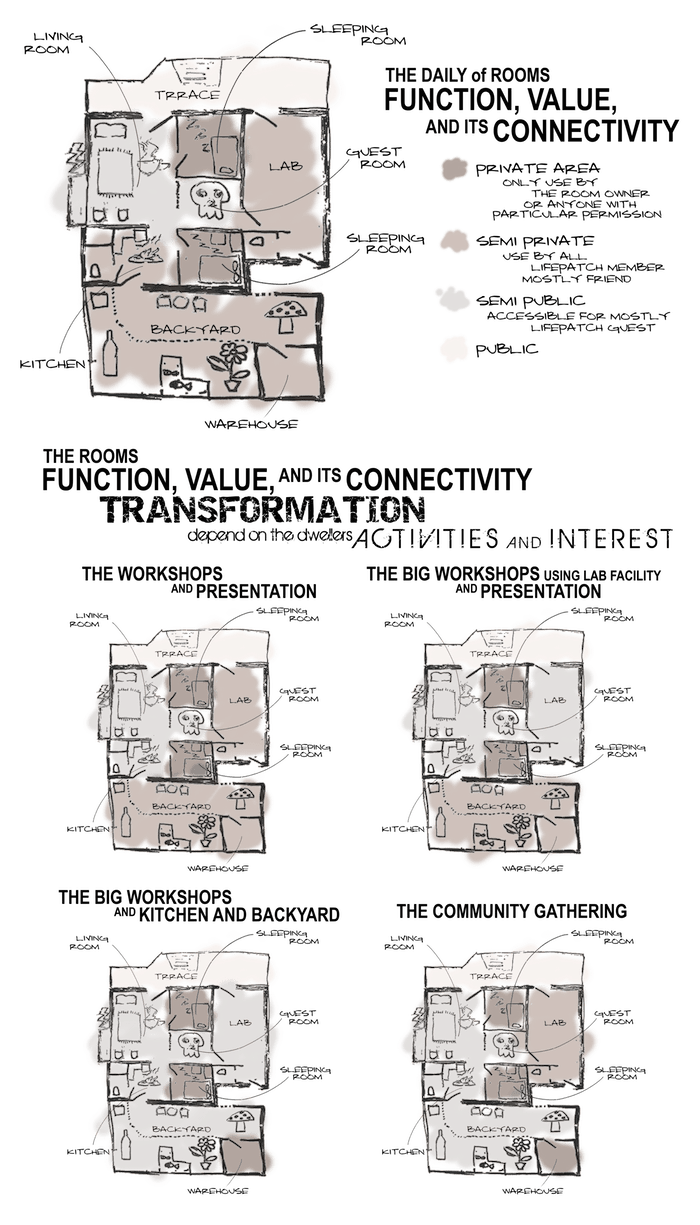
“Rumah” is an Indonesian word for the house. However, most people in Indonesia include Lifepatch, and many collective communities or organizations who use House as their main space aren’t describing the house as just a type of permanent physical structure with a particular function as a shelter or a Residential Building. There are several attributes that defining it as a “home”, such as self-consciousness, sense of belonging, histories, and a place where the dwellers practicing various ideas of better living concepts through simple hacking as an effort to survive.
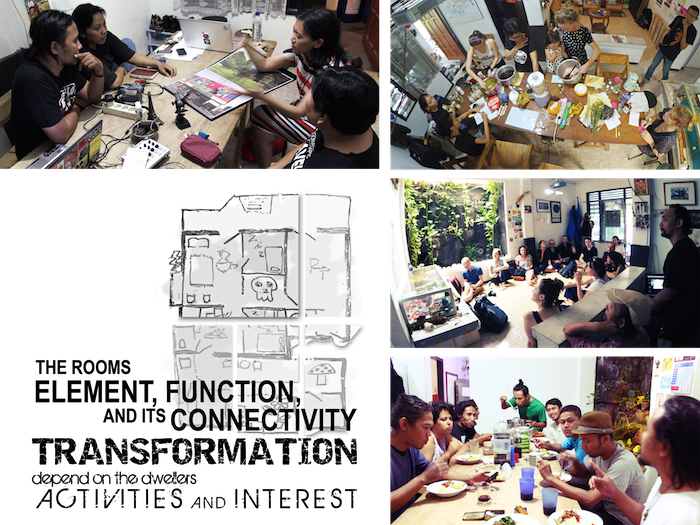
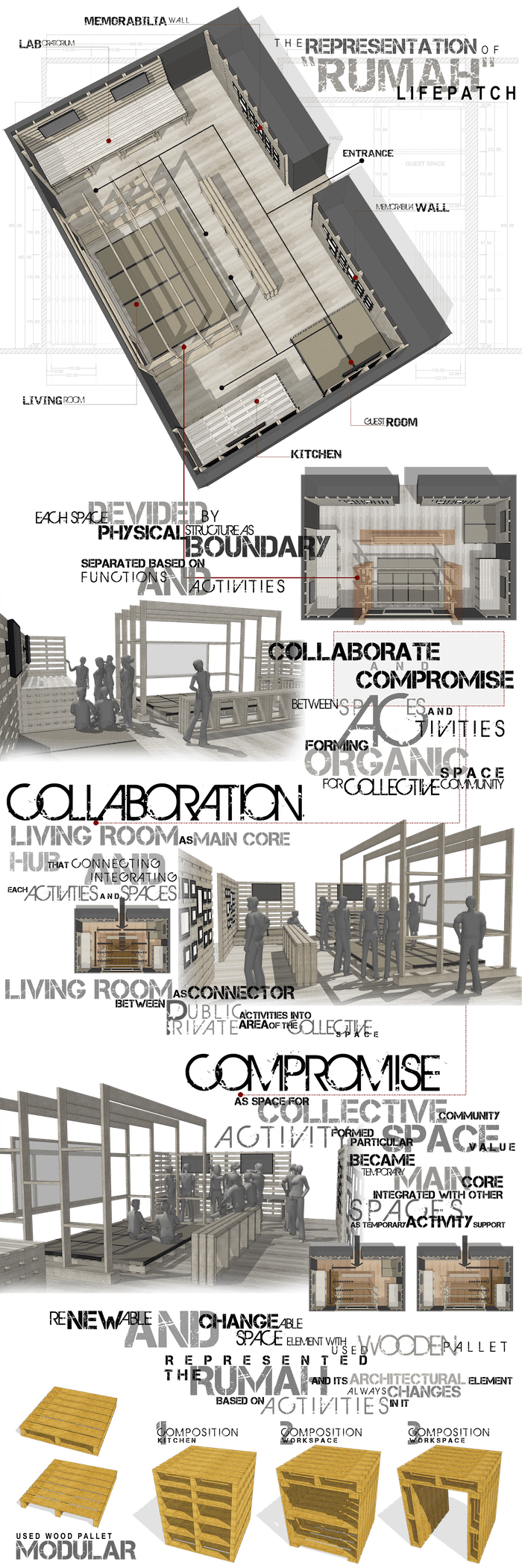
When examining thoroughly to presents the works and all activities of Lifepatch, there seems to be a tendency to put The Rumah as The main space to work and interact cooperatively with individuals and communities. As a space of collective community-based, Rumah of Lifepatch also represents its dweller’s strategy as a collective when practising their methods of dwelling in a place where private and public as place values and function can be connected or separated. The first part that also being called “Rumah” is the main area with private value and protected by a particular structure of a building. Basically, Rumah is the representative of its dweller’s internal affairs, which is an organic space that always growing and slightly changing based on the dweller’s effort to organize, compromise, and collaborate with each other to meet all their basic needs, interests, and activities. The second part called the “Halaman” or the courtyard. This part is a transition space provided by the Rumah dwellers to make both of connector and barriers between the concept of private and public. As a connector, the Halaman Rumah is a place for the dweller to meet every external aspect of the Rumah. Contrary, Halaman also became barriers that provide by the Rumah dwellers to protect their private area and all of its internal aspect.
However, talking about The Rumah of Lifepatch as a space for collective community-based, there seems to be a tendency that the Rumah is not just a mere physical structure with a particular function, but as an organic space that lives and slightly changes when projecting the dweller’s lives and activities. Meanwhile, as a form of dialogue, it provides a creative environment within its spaces for its dwellers to conduct creative activities through the works and interaction between the collective members and other community.
The Rumah Dan Halaman (House and courtyard) installation was designed based on those concepts as the reimagination of Lifepatch space with all of its activities, and brought it all into an art gallery space as part of The Collaboration Projects’ “Media Conscious” in Asia between Lifepatch, Japan Foundation Asia Center and NTT InterCommunication Center [ICC].
![WISNU [W] WISDANTIO](https://wisnuwisdantio.com/wp-content/uploads/2017/11/cropped-header-20172.jpg)

























 WISNU [W] WISDANTIO
You must be logged in to post a comment.