Pepper’s Ghost Holographic Projector With Single Reflector V.01.4

Prototype of The Pepper’s Ghost Projector V.01.4 as a science kit of a visual tool to display The Pepper’s Ghost holographic images
(2021)
___________________________________________


The Pepper’s Ghost Holographic Projector V.01.4 was developed as part of the STEAM educational course project called the “Illusionary Art Land”, a collaboration work between “Wawies” Wisnu, YANG Ching-wen (Bing Beng Club), Luyu and Yialin (Tur Ya Kar Elementary & Junior High School teachers) under the framework of The “New Taipei City Museum of Art 110th Annual Art STEAM Lesson Plan Development and Promotion Plan” from August 2021 to May 2022 in New Taipei City, Taiwan. Through the course, students explore basic projection principles of “Pepper’s Ghost illusion” based on the John Henry Pepper technique within the theatre performance of Charles Dickens’s “The Haunted Man” in 1862 to create “holographic ghostly image projection” and re-engineer the installation to enact their own Pepper’s Ghost.

The Magic Lantern How To Buy And How To Use It and How To Raise A Ghost by “A Mere Phantom” (1876)

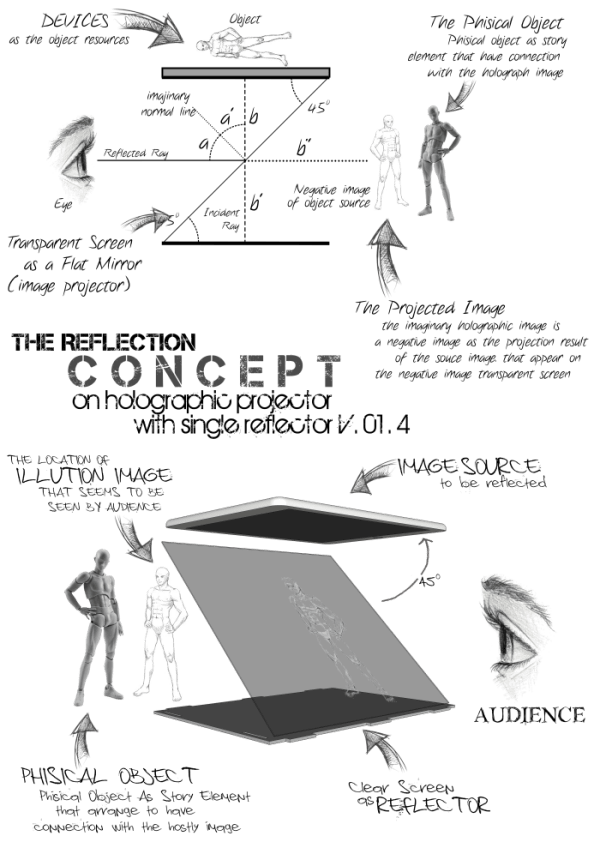
The V.01.4 prototype is developed under several contexts to support a STEAM education course that focuses on the importance of technology as a crucial part of children’s education. The course emphasises making the students more familiar with technology, learning how it works, and eventually working with it rather than simply engaging it as a user. The first determining factor is developing the V.01.4 prototype as a science learning kit, where the students learn how the “Pepper’s Ghost illusion” technique actually works and eventually build a tool to re-enacting it that utilises the law of reflection to create a ghostly image as a reflection of an actual object through a transparent mirror.  The second factor is the need to design to be integrated with digital technology-based devices that are affordable and accessible easily to students in their daily lives, such as the Internet, smartphones, tablets, and other forms of digital devices. Where in this case, those devices are provided by their school as tools for students to learn how to design their own artwork or even make a simple animation as the source image to be projected by Pepper’s Ghost Holographic Projector V.01.4 in the form of a virtual ghostly character.

Driven by the first contexts, The V.01.4 prototype design is developed by re-examining the previous versions of Pepper’s Ghost Projector, especially the mini version of the V.01.3 projector prototype that was designated as an exhibition installation to present certain content. Thus, there was a need to customize the V.01.3 design to meet its development purposes as part of an educational course. The first idea is to bring the V.01.4 mechanism developed based on the V.01.3 design and reduce its mechanism to adopt John Pepper’s installation simplicity that was utilized within “The Haunted Man” performance production in 1862, which only implements a simple transparent screen to enact the ghostly figure illusion. The other thing is the connectivity or interaction between the illusion and the other actors or even the physical environment during the performance that emphasises the illusion’s ghostly appearance. So, besides implementing the transparent screen with a simple mechanism to enact the illusion, the V.01.4 prototype can also be used to present a physical object and the real environment behind the transparent screen.
Meanwhile, following the first context that focused on learning how the Pepper Ghost illusion mechanism works, the second context drives the development of  V.01.4 prototype design as an interactive learning kit in the form of a simple knock-down kit that is easy to build, a simplified version of the Do-It-Yourself installation, which is suitable to be built by students at different education stages whether individually or in-group and enriches them with experiences in design thinking, hands-on operation, as well as improves their problem-solving skills.

Those design contexts drive the V.01.4 development by enhancing and customizing the former V.01.3 prototype design, which is designed to be integrated with an iPad as a digital technology-based device that is affordable and accessible easily nowadays. Within the exploration process from August until November of 2021, the development of the Pepper’s Ghost Holographic Projector With Single Reflector V.01.4 model spread into several developments, such as:

  • Following the idea of the Mini V.01.3 design, the V.01.4 is designed for a tablet computer with a 10″ display size as the source image or object. As well as keep using the 3/4 mm plexiglass as the transparent sheet reflector.
  • The V.01.4 model is also designed with 2 compartments, which are the illusion mechanism compartment and the holographic projection with the physical object compartment. However, instead of using a flat mirror as the image converter, the V.01.4 model is designed without a mirror element in order to make the mechanism as simple as possible and keep the source image still hidden in the illusion mechanism compartment.
  • The other customisation is replacing the stage for the physical object compartment. instead of using a stage to place a physical object, the wall on the projection compartment is being cut and the image will be projected in a hollow place where the audience can see the environment behind the V.01.4 projector box.
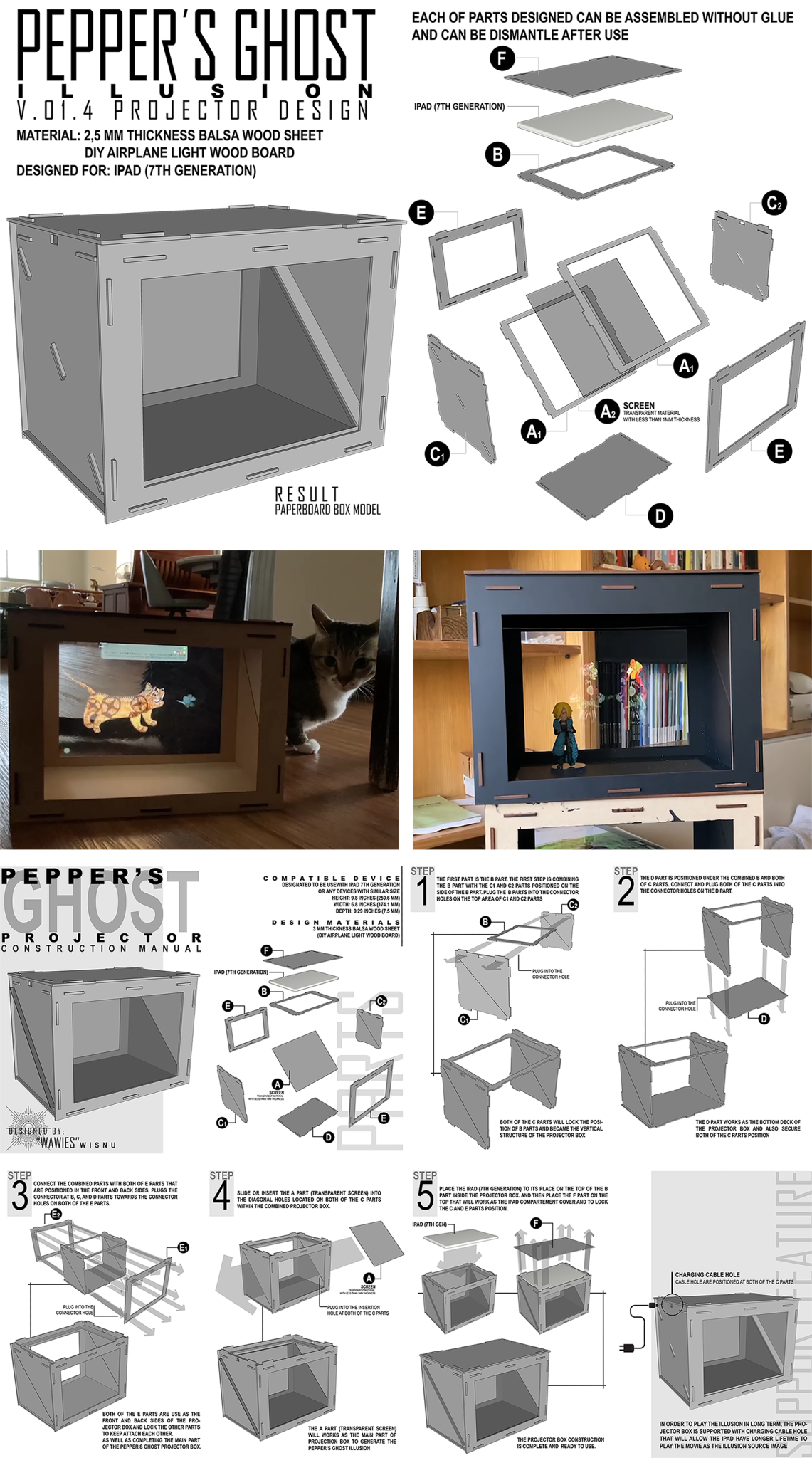
  • The last customisation of Pepper’s Ghost Holographic Projector With Single Reflector V.01.4 model was designed in the form of a simple knock-down kit that is easy to build.

Those developments brought the first sketch idea of the V.01.4 projector design concept, which is influenced by a shoe box design where easy to find as a common thing in almost every household.

However, after reviewing and building the first prototype, several flawless were found in the construction process. The building process is considered too complicated and takes a lot of time. In other circumstances, since the parts are connected to each other with glue, it appears that the connections tend to be weak and easy to fall apart. It brings a new idea to make the projector box in the form of a simple knock-down as if a puzzle, where each part is connected through a pin and hole system. A system where it can be built easily and can be dismantled after use.


Illusionary Art Land (幻遊藝境) – Pepper’s Ghost Holographic Projection Science Kit

The Science-Kit Design project as part of the art STEAM education courses for elementary school students under the framework of “New Taipei City Art Museum’s Annual Art STEAM teaching plan development 2021”
(2021 – 2022)
___________________________________________


The “New Taipei City Art Museum’s Annual Art STEAM Teaching Plan Development 2021” is a framework of educational promotion and course plans as an annual program of the New Taipei City Museum of Art organized by Hide & Seek Audiovisual Art. Under the framework, artists and teachers were invited and matched to develop art STEAM (Science, Technology, Engineering, Art, Math) teaching course plans with art as the core that is suitable for students at different education stages, combining multiple cross-domain, design thinking, hands-on operation and improve the problem-solving skills.

In the 2021 Art Steam annual program, “Wawies” Wisnu Wisdantio works as a co-artist for Yang Ching-wen (Club Bing Beng) who work together with Wang Lu-Yu and Fang Ya-Ling as teachers to develop the art STEAM course “Illusionary Art Land (幻遊藝境)” for students at Tur Ya Kar Elementary & Junior High School (桃子腳國中小) from October 2021 to February 2022. The course focuses on the importance of technology as a crucial part of children’s education and emphasises the idea of making the students more familiar with technology, learning how it works, and eventually working with it rather than simply engaging it as a user.

Source: STEAM Lesson Planning Project 2021 Webpage

Within The Illusionary Art Land (幻遊藝境) course, Yang Ching-wen has an opportunity to work with art class students at Tur Ya Kar Elementary & Junior High School (桃子腳國中小) and represents how an illusion technique can be utilised to create a “holographic ghostly image projection”. It’s an ancient mechanism based on natural physics that was revived by British scientist Henry Dircks and popularized by John Henry Pepper who implemented it into a theatre performance of Charles Dickens’s “The Haunted Man” in 1862. Until recently, the technique called Pepper’s Ghost Illusion has been adopted and developed into various forms of sophisticated technology as part of modern performing arts. At the first step of the course, students had an opportunity to learn the basic principles of projection works and explore how to re-engineer a simple pyramid plexiglass to transform an image or animation from their smartphone into an optical illusion technique called “Pepper’s Ghost illusion” or even play with light to enact their own ghostly characters.

Documentation by Wang Lu-Yu and Fang Ya-Ling

Meanwhile, teacher Lu-yu and teacher Ya-ling work together in the course to guide the students to create their own ghostly characters through their toys or various objects. When most of the time those things are only alive within the student’s imagination, with the help of affordable devices such as smartphones or tablet computers that are easily accessible to students in their daily lives, the students have an opportunity to explore and bring their imagination into reality as if those characters can really move or alive. Where they learn how to make a simple animation from their toys with the Stop Motion technique, it is a technique in which objects are physically manipulated in small increments between individually photographed frames so that they will appear to exhibit independent motion or change when the series of frames is played back. In the end, through this process, the students can create their own character animation based on their own stories or imagination to be displayed virtually with Pepper’s ghost installation and presented within a small exhibition at their school.

Documentation by Wang Lu-Yu and Fang Ya-Ling

In order to support the art STEAM course “Illusionary Art Land,” which focuses on teaching students how technology works and how to work with it, “Wawies” Wisnu participates in developing a customized design for Pepper’s Ghost installation. Instead of presenting it as a fixed or ready-to-use installation, he designed the V.01.4 model in a knock-down kit, a simplified version of the Do-It-Yourself installation that can be assembled by the student during the course and dismantled back after use. As a science kit, this model is expected to be suitable to be built by students at different education stages whether individually or in-group and enrich their exploration process with experiences in design thinking, hands-on operation, and improving their problem-solving skills.

The Pepper’s Ghost V.01.4 Projector Design And The Assembling Booklet


Documentation by Wang Lu-Yu and Fang Ya-Ling

Eventually, the students were divided into several working groups and finished building their own V.01.4 projector guided by the step-by-step assembly instructions, they stepped into the final part of The Illusionary Art Land (幻遊藝境) course. Each student group used the projector to convert their “Stop-Motion” artwork video into a holographic character and present it to their friends in a small exhibition within the Tur Ya Kar Elementary & Junior High School (桃子腳國中小).

“Illusionary Art Land” (幻遊藝境) Exhibition Documentation
courtesy of Tur Ya Kar Elementary & Junior High School (桃子腳國中小) teachers Documentation


Research And Development Documentation:
* The Pepper’s Ghost V.01.4 Science Kit Projector Development Documentation

Reference Site:
* Details of “New Taipei City Art Museum’s Annual Art STEAM Teaching Plan Development 2021” On New Taipei City Art Museum’s official website.
* Details of Hide & Seek Audiovisual Art official website.
* Details of Club Bing Beng on the Facebook page.
* Details of Tur Ya Kar Elementary & Junior High School (桃子腳國中小) official website.


Delirious LandLord

A board game as an interactive installation made in the context of Jinguashi – Shuinandong – Jiufen and represents those areas’ identity changes throughout the time
(2019)
___________________________________________


“Delirious LandLord” is an interactive installation of collaboration work between “Wawies” Wisnu Wisdantio and Nova Rachmad Basuki (Nopel). It’s part of an interconnected installations exhibition titled Deposits Of The Island by Open Contemporary Art Center (OCAC) and Lifepatch under the framework of the 2019 Asian Art Biennial with the main title The Strangers from beyond the Mountain and the Seain the National Taiwan Museum of Fine Arts – Taichung, Taiwan, from 5 October 2019 until 9 February 2020, curated by Chia-Wei Hsu and Ho Tzu Nyen.

Asian Art Biennale 2019 “The stranger from the mountains and the sea” video teaser
courtesy of the National Taiwan Museum of Fine Arts Official Youtube Channel on youtube.com

The collaborative work, Deposits of the Island, aims to build a place of encounter and exchange. It invites audience to become the agents in this journey, using sound and playful games as a medium to evoke hidden stories and to “extract” the layers of historical, geographical, and memory in Jinguashi. It also dives into the body memories of migrant workers gathering around ASEAN Plaza and aims to initiate dialogues through the touch of massage. With this work, OCAC and Lifepatch aim to lead the audience through the “hand of the deities” — to learn the spices, herbs, and liquor from Taiwan and Indonesia, and further explore their customs, histories, cultures, and transformative impacts in the contemporary world.

– exhibition curatorial, 2019 –

The Shuinandong Smelter on panorama view of Lianxin Village, Ruifang District

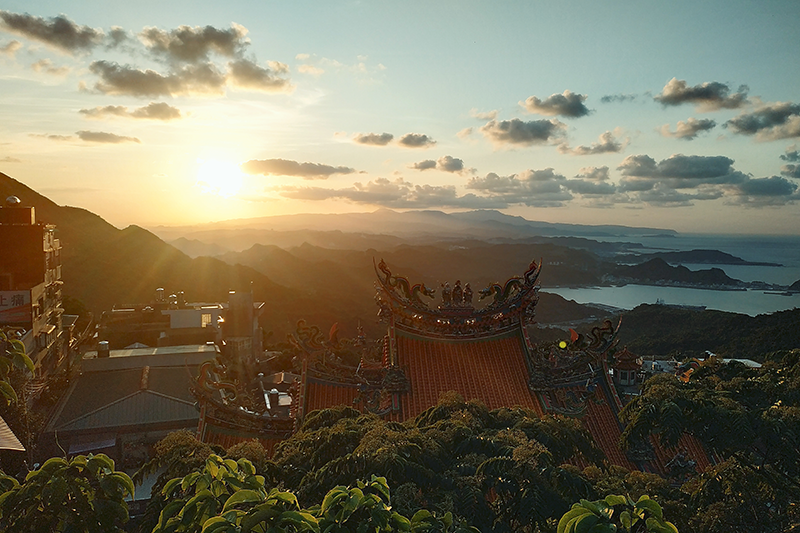
Large tiered construction with a fortress-like appearance known as “The Remains of the 13 Levels” stands firm following the hillside of Ruifang district. Although abandoned for decades and slowly engulfed by nature, those Shuinandong smelter remnants’ iconic size and spectacular setting never failed to show the gold rush glorious era in the early 1930s, an era that drove the Jiufen and Jinguashi developed as prosperous gold mining towns. Unfortunately, the depletion of gold ore deposits led the mining companies into bankruptcy and shut down the Shuinandong Smelter around the 1973s.  Shortly, the charms of prosperous mining towns faded off, and its citizens slowly abandoned their houses with only a few left who chose to stay and struggle to survive.

Despite being abandoned, forgotten, and isolated in the hill country for many years, this seems to have allowed those towns to preserve most of their past stories about prosperity and despair. Eventually, it attracted a film director – Hou Hsiao-Hsien – to use Jiufen town in his film project, entitled “A City of Sadness”. A historical drama film project that turned out to be a controversial film after its release in 1987. It is the first film that depicts the Taiwan dark historical event of the February 28 Incident as the story background when it was still considered a highly sensitive subject and prohibited from being discussed in public. However, it becomes too famous to be silenced after winning the Golden Lion Award at the Venice International Film Festival and hitting the box office. It encourages people to talk about part of their history that was suppressed or considered taboo. as well as encourages People who wanted to reconnect with their histories to start swarming those old mining towns in the early ’90s. Eventually, it drove Jiufen and the other mining towns re-known and woke up after a long stretch of time drowning in a deep sleep.

As if being hit by a new kind of gold rush, tourism blasts ignited the rows of empty and abandoned old buildings in Juifen being reused as houses, small inns, museums, souvenir shops, pottery shops, local food stalls, and tea houses. Filling the rural town’s old narrow streets with pleasant smells along with the lively sights and sounds of local people’s culture within their routine life. The crowds also start swarming the Riufang district widely, spreading from the Jinguashi settlement until far across the entire hills and reaching the seashore of Shuinandong. Those former mining towns constantly grow into famous cultural tourism destinations and attract influxes of people who want to feel the authentic impression of local culture and learn more about Shuinandong – Jinguashi – Jiufen historical stories. In the end, it also attracted the government to invest a large number of funds to hastening those rural towns into one of the New Taipei City economic pillars through tourism, such as providing public transportation facilities and tourism infrastructure.

As we sift through the scattered fragments of those towns’ history and experience walking through their narrow streets, we find a hint of a hidden layer that is implied along with the long stories about gold and prosperity. It appears that instead of being developed organically, the transformation of identity, sociocultural characteristics, and even their ecological conditions tends to occur – directly and indirectly – due to the interference of “Strangers” who show up one after another in various forms. Ranging from gold mine companies, colonizers, artists, entrepreneurs, investors, or even the government, each of those figures has their own perspective to determine the value of Riufang district, as well as manages that hilly area based on their own specific goals and interests. On the other hand, though the dwellers seem helpless and trapped as spectators who keep struggling to survive, some also have a significant role as actors. Their ability to adapt to every transformation and persistence to preserve their daily culture eventually nourished those rural towns’ “Spirit of Place”. In other words, the “Strangers” and even the “Dwellers” take a role in determining the space’s identity and even change it into another identity based on their particular interest, as well as the figure who chooses to don’t take action and just follows their living space transformation became valuable things that emphasize the whole story of Riufang hilly area.

The tendency that the significant role of “Strangers” or even the “Dwellers” get buried as a hidden layer overshadowed by nostalgic narratives of prosperity and despair drives our interest to re-enact those Strangers’ contributions as narrations fragments that shaped the whole history of Shuinandong – Jingashi – Juifen. Instead of representing it in the form of a historical narrative full of dates, names, and even complex historical event notes,  which tend to be monotonous and sometimes less engaging storytelling process, the narratives of how the “Stranger” can determine the space’s identity and even can change it into another identity is presented side by side with Riufang Hill’s history in the form of an interactive role-playing game installation as if a monopoly board game. Driven by this idea, under collaboration work with Nova Rachmad Basuki (Nopel), we created “Delirious LandLord” as an interactive installation based on the classic Monopoly board game.

“Delirious LandLord” is a customized Monopoly board game that delivers its player on a captivating virtual journey through various places spread across the Riufang hilly area. As if playing the classic Monopoly board game, focusing on buying, trading, and developing properties. The main objective of The Delirious Landlord is to try to deliver its players a deeper understanding of how their role as a “Stranger” understand each place’s in-game identity and how they can determine their act while defining each place as a property. Meanwhile, at the same time, the players can also learn that their activities area resemble the historical significance of the Strangers and how their act can have an impact towards the Riufang hilly area and its society in the real event.

“Delirious LandLord” display video – “Deposits Of The Island” – Asian Art Biennale 2019 “The stranger from the mountains and the sea”
Video by Nova Rachmad Basuki (Nopel) (Lifepatch)

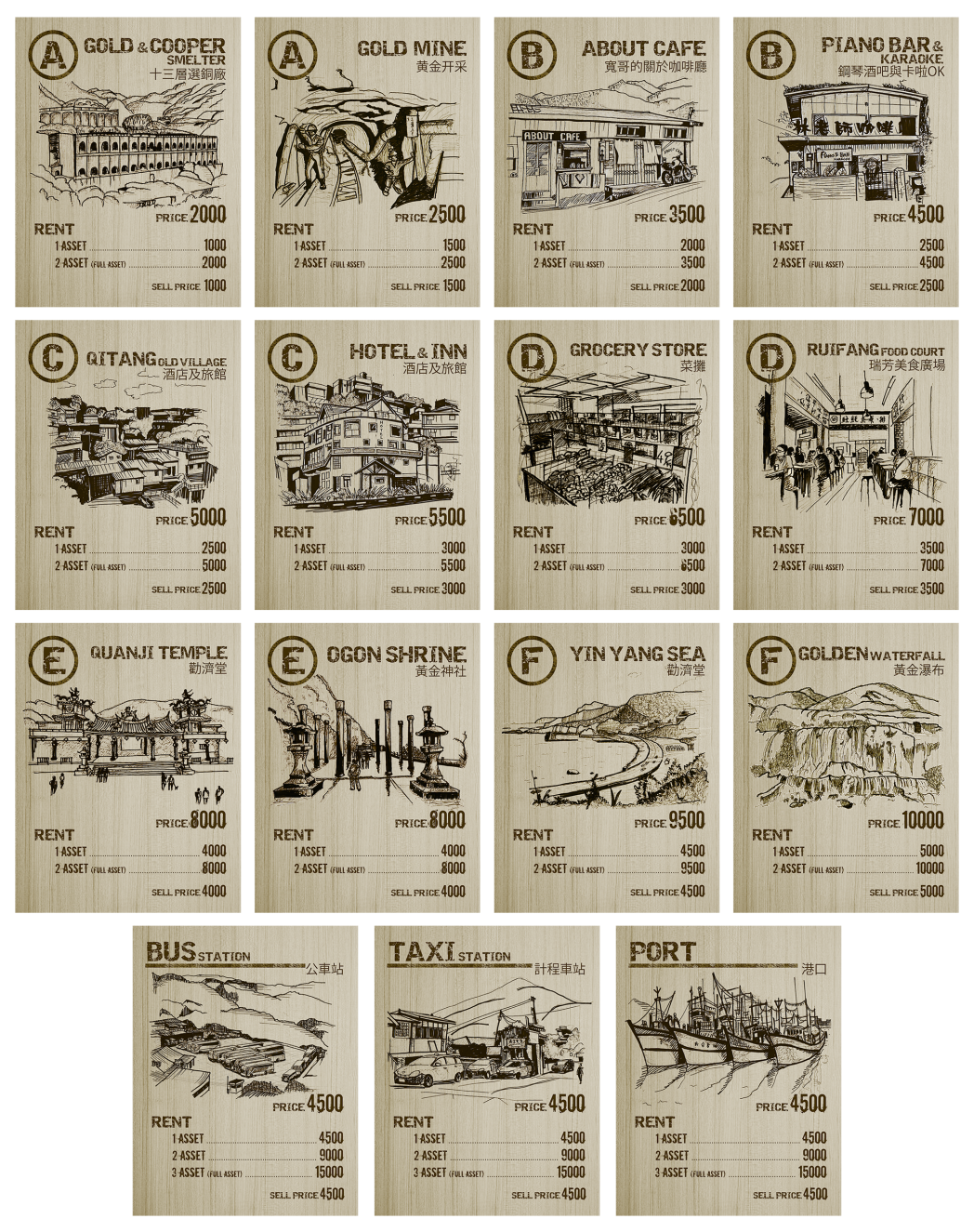
“Delirious Landlord Property Cards” Design by “Wawies” Wisnu Wisdantio, Sketches by Andi Pratomo

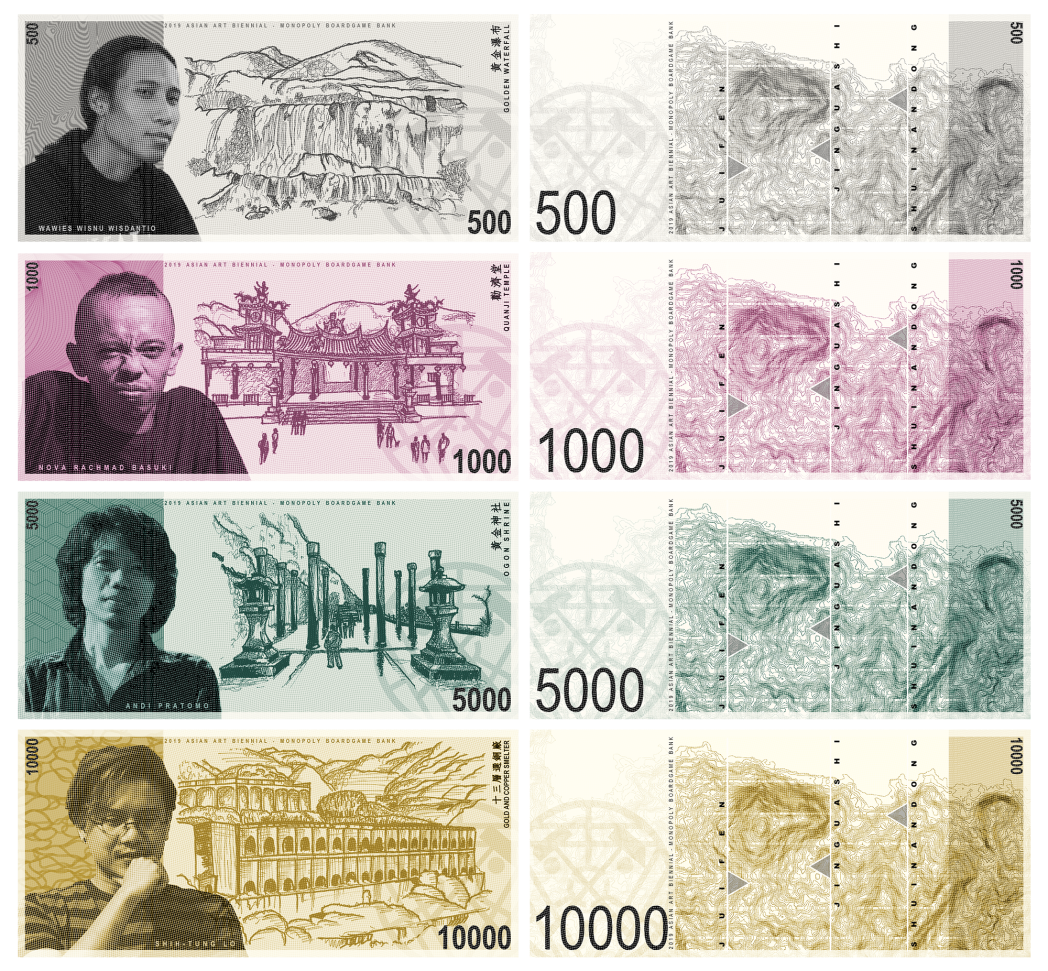
“Delirious Landlord Money” Design by “Wawies” Wisnu Wisdantio, Sketches by Andi Pratomo. (Talent Figure: “Wawies” Wisnu Wisdantio, Nova Rachmad Basuki (Nopel), Andi Pratomo, Shih-Tung Lo)

The identity of an area and how it changes into another identity often occurs because of some people’s interest.
Similar to the way when playing a property board game called the Monopoly game.
Not just driven the ecological changes, it also impacts the dweller’s way of life.
They are forced to adapt in order to survive in every condition.
However, will they choose to take the role of audiences and float within the flow of the game?
Or will they choose to take the role an actor who can influence and determine their own identity in the future?
What about you?

___________________________________________

Delirious Landlord within “Deposits Of The Island” exhibition on Asian Art Biennale 2019 “The stranger from the mountains and the sea” – Artist Talk Video

courtesy of National Taiwan Museum of Fine Arts Official Youtube Channel on youtube.com