

(2019)
“Delirious LandLord” is an interactive installation of collaboration work between “Wawies” Wisnu Wisdantio and Nova Rachmad Basuki (Nopel). It’s part of an interconnected installations exhibition titled “Deposits Of The Island“ by Open Contemporary Art Center (OCAC) and Lifepatch under the framework of the 2019 Asian Art Biennial with the main title “The Strangers from beyond the Mountain and the Sea” in the National Taiwan Museum of Fine Arts – Taichung, Taiwan, from 5 October 2019 until 9 February 2020, curated by Chia-Wei Hsu and Ho Tzu Nyen.

Asian Art Biennale 2019 “The stranger from the mountains and the sea” video teaser
courtesy of the National Taiwan Museum of Fine Arts Official Youtube Channel on youtube.com
The collaborative work, Deposits of the Island, aims to build a place of encounter and exchange. It invites audience to become the agents in this journey, using sound and playful games as a medium to evoke hidden stories and to “extract” the layers of historical, geographical, and memory in Jinguashi. It also dives into the body memories of migrant workers gathering around ASEAN Plaza and aims to initiate dialogues through the touch of massage. With this work, OCAC and Lifepatch aim to lead the audience through the “hand of the deities” — to learn the spices, herbs, and liquor from Taiwan and Indonesia, and further explore their customs, histories, cultures, and transformative impacts in the contemporary world.
– exhibition curatorial, 2019 –
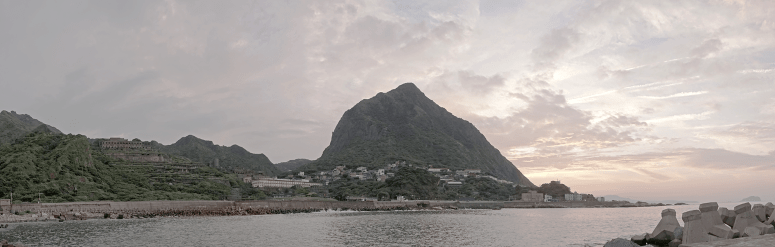
Large tiered construction with a fortress-like appearance known as “The Remains of the 13 Levels” stands firm following the hillside of Ruifang district. Although abandoned for decades and slowly engulfed by nature, those Shuinandong smelter remnants’ iconic size and spectacular setting never failed to show the gold rush glorious era in the early 1930s, an era that drove the Jiufen and Jinguashi developed as prosperous gold mining towns. Unfortunately, the depletion of gold ore deposits led the mining companies into bankruptcy and shut down the Shuinandong Smelter around the 1973s. Shortly, the charms of prosperous mining towns faded off, and its citizens slowly abandoned their houses with only a few left who chose to stay and struggle to survive.


Despite being abandoned, forgotten, and isolated in the hill country for many years, this seems to have allowed those towns to preserve most of their past stories about prosperity and despair. Eventually, it attracted a film director – Hou Hsiao-Hsien – to use Jiufen town in his film project, entitled “A City of Sadness”. A historical drama film project that turned out to be a controversial film after its release in 1987. It is the first film that depicts the Taiwan dark historical event of the February 28 Incident as the story background when it was still considered a highly sensitive subject and prohibited from being discussed in public. However, it becomes too famous to be silenced after winning the Golden Lion Award at the Venice International Film Festival and hitting the box office. It encourages people to talk about part of their history that was suppressed or considered taboo. as well as encourages People who wanted to reconnect with their histories to start swarming those old mining towns in the early ’90s. Eventually, it drove Jiufen and the other mining towns re-known and woke up after a long stretch of time drowning in a deep sleep.
As if being hit by a new kind of gold rush, tourism blasts ignited the rows of empty and abandoned old buildings in Juifen being reused as houses, small inns, museums, souvenir shops, pottery shops, local food stalls, and tea houses. Filling the rural town’s old narrow streets with pleasant smells along with the lively sights and sounds of local people’s culture within their routine life. The crowds also start swarming the Riufang district widely, spreading from the Jinguashi settlement until far across the entire hills and reaching the seashore of Shuinandong. Those former mining towns constantly grow into famous cultural tourism destinations and attract influxes of people who want to feel the authentic impression of local culture and learn more about Shuinandong – Jinguashi – Jiufen historical stories. In the end, it also attracted the government to invest a large number of funds to hastening those rural towns into one of the New Taipei City economic pillars through tourism, such as providing public transportation facilities and tourism infrastructure.


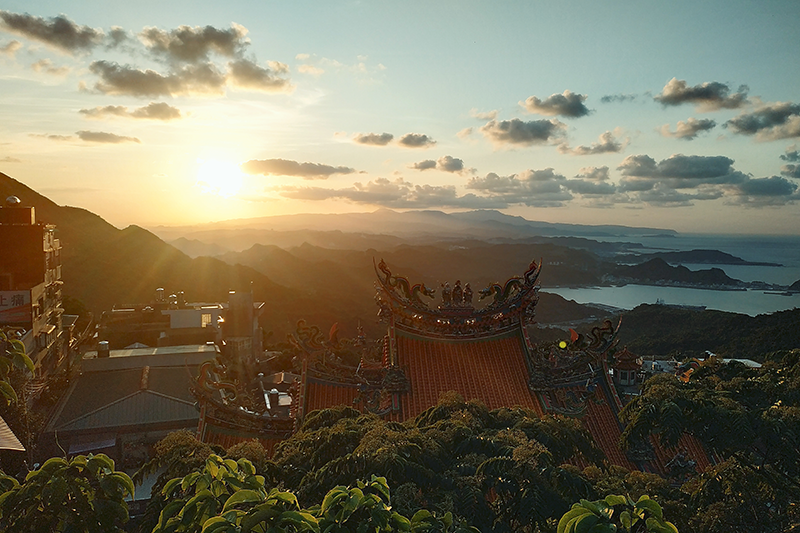
As we sift through the scattered fragments of those towns’ history and experience walking through their narrow streets, we find a hint of a hidden layer that is implied along with the long stories about gold and prosperity. It appears that instead of being developed organically, the transformation of identity, sociocultural characteristics, and even their ecological conditions tends to occur – directly and indirectly – due to the interference of “Strangers” who show up one after another in various forms. Ranging from gold mine companies, colonizers, artists, entrepreneurs, investors, or even the government, each of those figures has their own perspective to determine the value of Riufang district, as well as manages that hilly area based on their own specific goals and interests. On the other hand, though the dwellers seem helpless and trapped as spectators who keep struggling to survive, some also have a significant role as actors. Their ability to adapt to every transformation and persistence to preserve their daily culture eventually nourished those rural towns’ “Spirit of Place”. In other words, the “Strangers” and even the “Dwellers” take a role in determining the space’s identity and even change it into another identity based on their particular interest, as well as the figure who chooses to don’t take action and just follows their living space transformation became valuable things that emphasize the whole story of Riufang hilly area.
The tendency that the significant role of “Strangers” or even the “Dwellers” get buried as a hidden layer overshadowed by nostalgic narratives of prosperity and despair drives our interest to re-enact those Strangers’ contributions as narrations fragments that shaped the whole history of Shuinandong – Jingashi – Juifen. Instead of representing it in the form of a historical narrative full of dates, names, and even complex historical event notes, which tend to be monotonous and sometimes less engaging storytelling process, the narratives of how the “Stranger” can determine the space’s identity and even can change it into another identity is presented side by side with Riufang Hill’s history in the form of an interactive role-playing game installation as if a monopoly board game. Driven by this idea, under collaboration work with Nova Rachmad Basuki (Nopel), we created “Delirious LandLord” as an interactive installation based on the classic Monopoly board game.

“Delirious LandLord” is a customized Monopoly board game that delivers its player on a captivating virtual journey through various places spread across the Riufang hilly area. As if playing the classic Monopoly board game, focusing on buying, trading, and developing properties. The main objective of The Delirious Landlord is to try to deliver its players a deeper understanding of how their role as a “Stranger” understand each place’s in-game identity and how they can determine their act while defining each place as a property. Meanwhile, at the same time, the players can also learn that their activities area resemble the historical significance of the Strangers and how their act can have an impact towards the Riufang hilly area and its society in the real event.
“Delirious LandLord” display video – “Deposits Of The Island” – Asian Art Biennale 2019 “The stranger from the mountains and the sea”
Video by Nova Rachmad Basuki (Nopel) (Lifepatch)
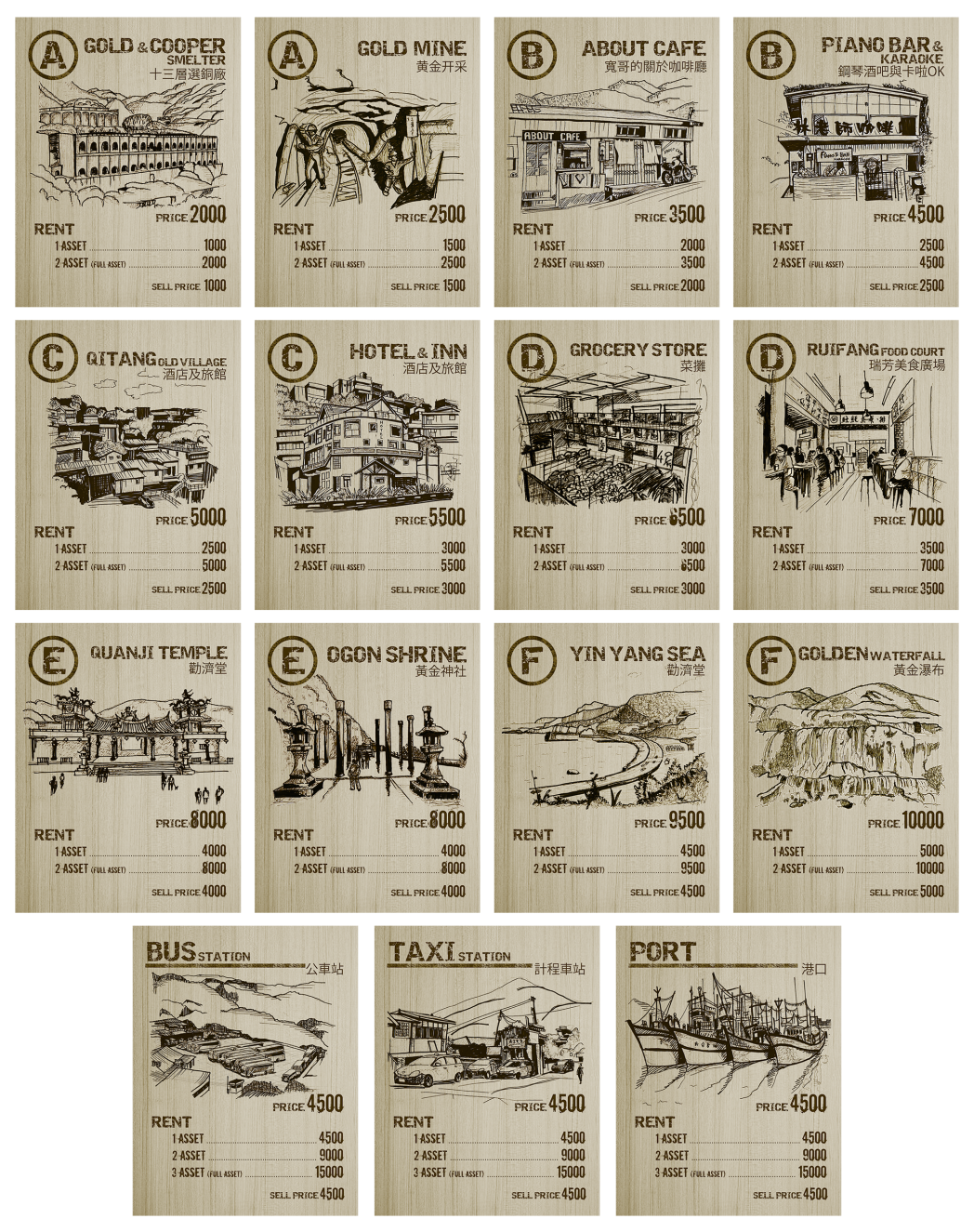
“Delirious Landlord Property Cards” Design by “Wawies” Wisnu Wisdantio, Sketches by Andi Pratomo
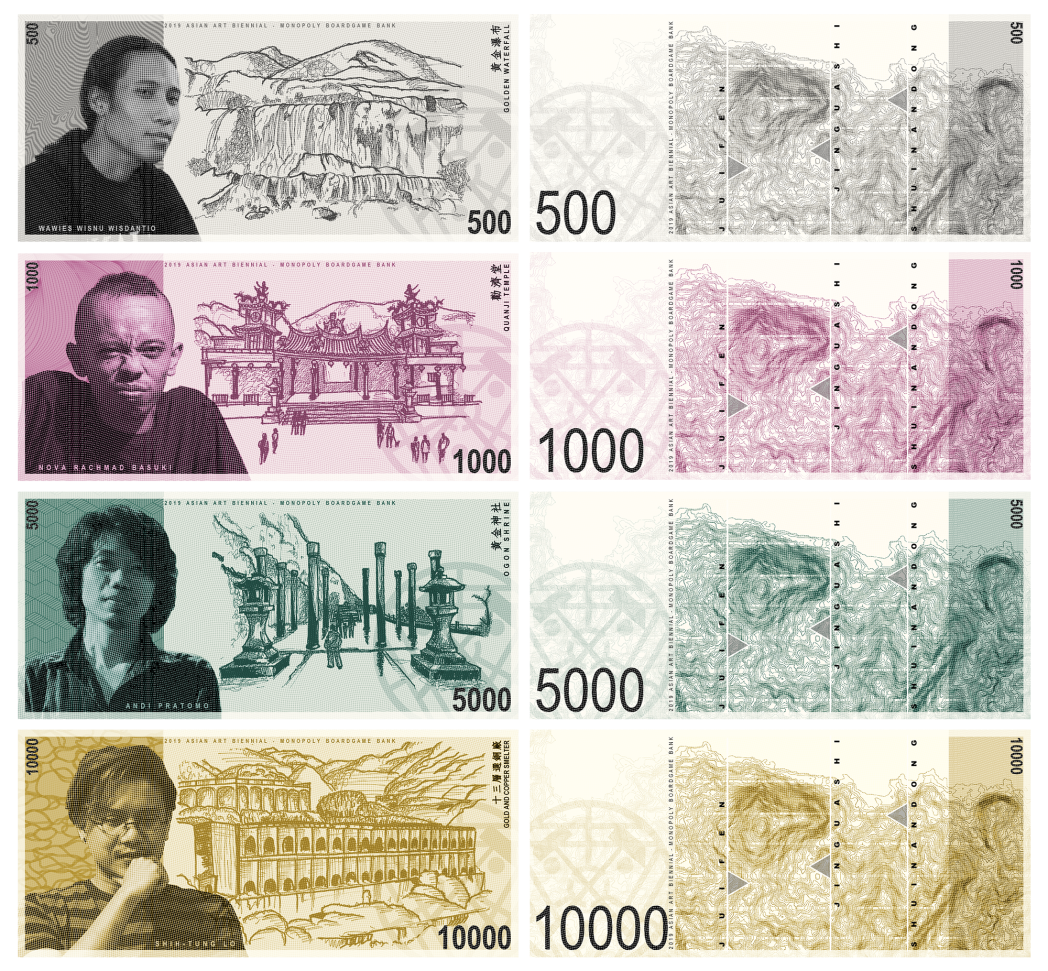 “Delirious Landlord Money” Design by “Wawies” Wisnu Wisdantio, Sketches by Andi Pratomo. (Talent Figure: “Wawies” Wisnu Wisdantio, Nova Rachmad Basuki (Nopel), Andi Pratomo, Shih-Tung Lo)
The identity of an area and how it changes into another identity often occurs because of some people’s interest.
Similar to the way when playing a property board game called the Monopoly game.
Not just driven the ecological changes, it also impacts the dweller’s way of life.
They are forced to adapt in order to survive in every condition.
However, will they choose to take the role of audiences and float within the flow of the game?
Or will they choose to take the role an actor who can influence and determine their own identity in the future?
What about you?
___________________________________________
Delirious Landlord within “Deposits Of The Island” exhibition on Asian Art Biennale 2019 “The stranger from the mountains and the sea” – Artist Talk Video
courtesy of National Taiwan Museum of Fine Arts Official Youtube Channel on youtube.com
 WISNU [W] WISDANTIO
You must be logged in to post a comment.